
The Australian Dollar (AUD) maintained its strength against the US Dollar (USD) on Thursday following the People’s Bank of China (PBoC) interest rate decision. China’s central bank decided to leave key loan rates unchanged in November. The loan risk coverage ratio for one year and five years was 3.00% and 3.50%, respectively. Since China and Australia are close trading partners, China’s official interest rates can influence the Australian dollar.
“Sustained above-trend growth could lead to increased inflationary pressures,” RBA Assistant Governor Sarah Hunter said on Thursday. Hunter noted that monthly inflation data can be volatile and that the central bank will not react to one month’s numbers. She added that the RBA closely assesses labor market conditions to gauge supply capacity and considers how the effects of monetary policy may change over time.
The Australian dollar finds support as expectations increase for a dovish stance from the Reserve Bank of Australia (RBA). Minutes from the Reserve Bank of Australia’s November meeting indicated that the central bank may keep interest rates unchanged for an extended period if economic data continues to outperform. Steady wage growth in the third quarter, last week’s strong jobs numbers, and persistently high inflation have all reinforced the view that the monetary easing cycle is likely over.
ASX 30-day interbank rate futures show that as of November 18, the December 2025 contract was trading at 96.41, implying an 8% probability of the interest rate being cut to 3.35% from 3.60% at the next RBA board meeting.
The US dollar rose on lower interest rate cut bets from the Federal Reserve
- The US Dollar Index (DXY), which measures the value of the US dollar against six major currencies, remains stronger and is trading around 100.20 at the time of writing. Traders await the release of the US September non-farm payrolls (NFP) report later on Thursday, to gain new momentum on the Federal Reserve’s policy outlook.
- The dollar rose more than 0.5% in the previous session as markets lowered their expectations for another interest rate cut by the Federal Reserve (US central bank) in December following the minutes of the Federal Open Market Committee (FOMC) meeting.
- Minutes from the October 28-29 Federal Open Market Committee meeting indicated that Fed officials are divided and cautious about the future path of interest rates. Most respondents indicated that further rate cuts would likely be appropriate over time, but several indicated that they did not necessarily see a cut in December as appropriate.
- CME’s FedWatch tool indicates that financial markets are now pricing in a 33% probability that the Fed will cut its benchmark overnight borrowing rate by 25 basis points at its December meeting, down from the 63% probability that markets had priced in a week ago.
- Richmond Federal Reserve Bank President Thomas Barkin said Tuesday that the labor market appears more balanced, with companies reporting improved worker availability and recent layoffs indicating a need for caution. Barkin noted that inflation does not appear to be rising, but it is also unclear whether it will return to the Fed’s 2% target. He stressed that without more conclusive data, it remains difficult to reach broad policy consensus.
- US President Donald Trump said in an Oval Office interview on Tuesday that he would “love” to fire Federal Reserve Chairman Jerome Powell immediately. Trump added that he already has a preferred candidate in mind for the position, noting that there are “some surprising names” under consideration, though the administration may ultimately choose a more traditional option.
- Federal Reserve Vice Chairman Philip Jefferson noted Monday that risks to the labor market now outweigh upside risks to inflation, while stressing that the Fed should proceed “slowly” with any additional interest rate cuts.
- U.S. Labor Department data released Tuesday showed there were 232,000 initial unemployment claims in the week ending October 18. Continuing claims came in at 1.957 million, up slightly from 1.926 million the previous week. For initial claims, weekly data for the previous three weeks were not provided. Meanwhile, the Automatic Data Processing (ADP) report showed that employers cut 2,500 jobs per week on average during the four weeks ending November 1.
- National Economic Council Director Kevin Hassett warned that some of the October data “may never be achieved,” as many agencies were unable to collect information during the shutdown. Initial private sector reports indicate a slowdown in the labor market and fluctuating consumer confidence, with continued concerns about inflation.
- Australia’s seasonally adjusted wage price index rose 0.8% quarter-on-quarter in the third quarter, unchanged from the previous period and in line with expectations. On an annual basis, wages rose by 3.4%, which is also in line with the previous quarter’s pace and market expectations.
- The Reserve Bank of Australia published the minutes of its November monetary policy meeting on Tuesday, suggesting that board members signaled a more balanced policy stance, adding that it could keep interest rates unchanged for longer if incoming data proves stronger than expected.
The Australian dollar is trading near 0.6500 after rebounding from the lower rectangle
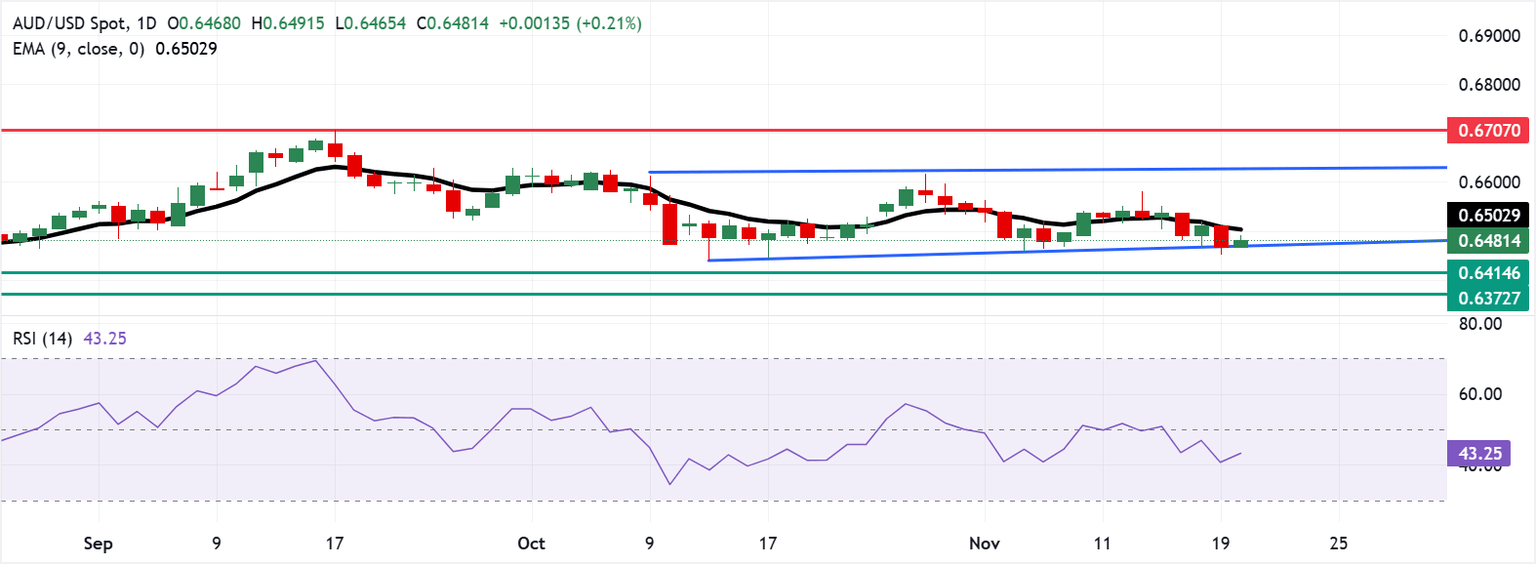
The AUD/USD pair is trading around 0.6480 on Thursday. Analysis of the daily chart indicates that the pair is moving sideways within a rectangular range, indicating a period of price consolidation. Meanwhile, the price remains below the nine-day exponential moving average (EMA), highlighting that the short-term price momentum is weaker.
On the downside, AUD/USD finds immediate support at the lower border of the rectangle around 0.6470, followed by a five-month low at 0.6414, which was hit on August 21.
The initial barrier is located at the psychological level at 0.6500, followed by the nine-day moving average at 0.6503. A break above the confluence resistance zone would improve the short-term price momentum and lead the pair to reach the upper border of the rectangle near 0.6630.
Australian dollar price today
The table below shows the percentage change in the Australian Dollar (AUD) against the major currencies listed today. The Australian dollar was the strongest against the Japanese yen.
| US dollars | euro | GBP | JPY | Canadian | Australian dollar | New Zealand dollar | Swiss franc | |
|---|---|---|---|---|---|---|---|---|
| US dollars | 0.07% | -0.05% | 0.33% | -0.00% | -0.20% | -0.19% | 0.05% | |
| euro | -0.07% | -0.12% | 0.24% | -0.08% | -0.27% | -0.24% | -0.02% | |
| GBP | 0.05% | 0.12% | 0.37% | 0.03% | -0.15% | -0.11% | 0.10% | |
| JPY | -0.33% | -0.24% | -0.37% | -0.33% | -0.51% | -0.51% | -0.27% | |
| Canadian | 0.00% | 0.08% | -0.03% | 0.33% | -0.18% | -0.18% | 0.06% | |
| Australian dollar | 0.20% | 0.27% | 0.15% | 0.51% | 0.18% | 0.03% | 0.25% | |
| New Zealand dollar | 0.19% | 0.24% | 0.11% | 0.51% | 0.18% | -0.03% | 0.22% | |
| Swiss franc | -0.05% | 0.02% | -0.10% | 0.27% | -0.06% | -0.25% | -0.22% |
The heat map shows the percentage changes in major currencies versus each other. The base currency is chosen from the left column, while the counter currency is chosen from the top row. For example, if you select the Australian dollar from the left column and move along the horizontal line to the US dollar, the percentage change displayed in the box will represent AUD (base)/USD (quote).
Frequently asked questions about the Australian dollar
One of the most important factors for the Australian Dollar (AUD) is the level of interest rates set by the Reserve Bank of Australia (RBA). Because Australia is a resource-rich country, another major driver is the price of its largest export, iron ore. The health of the Chinese economy, its largest trading partner, is one factor, in addition to Australia’s inflation, its growth rate and its trade balance. Market sentiment – whether investors are snapping up riskier assets (risk on) or looking for safe havens (risk off) – is also a factor, with risk appetite positive for the Australian dollar.
The Reserve Bank of Australia (RBA) influences the Australian dollar (AUD) by setting the level of interest rates that Australian banks can lend to each other. This affects the level of interest rates in the economy as a whole. The RBA’s main objective is to maintain a stable inflation rate of 2-3% by adjusting interest rates up or down. Relatively high interest rates compared to other major central banks support the Australian dollar, and relatively low interest rates. The RBA can also use quantitative easing and tightening to influence credit conditions, with the former being AUD negative and the latter AUD positive.
China is Australia’s largest trading partner, so the health of the Chinese economy has a major impact on the value of the Australian Dollar (AUD). When the Chinese economy is performing well, it buys more raw materials, goods and services from Australia, which raises demand for the Australian dollar, raising its value. The opposite is the case when the Chinese economy does not grow as quickly as expected. Therefore, positive or negative surprises in Chinese growth data often have a direct impact on the Australian dollar and its crosses.
Iron ore is Australia’s largest export, representing $118 billion annually according to 2021 data, and China is its main destination. Therefore, the price of iron ore could be a driver of the Australian dollar. In general, if the price of iron ore rises, the Australian dollar also rises, as overall demand for the currency increases. The opposite is the case if the price of iron ore falls. Higher iron ore prices also tend to increase the likelihood of a positive trade balance for Australia, which is also positive for the Australian dollar.
The balance of trade, which is the difference between what a country earns from its exports versus what it pays for its imports, is another factor that can affect the value of the Australian dollar. If Australia produces highly sought-after exports, its currency will gain value from the excess demand generated by foreign buyers seeking to buy its exports in exchange for what it spends to buy imports. Therefore, a positive net trade balance strengthens the Australian dollar, with the opposite effect if the trade balance is negative.

