The Japanese Yen (JPY) is still in decline against the broadly firmer US Dollar (USD) and is touching a new low since mid-February during the Asian session on Thursday. Concerns about Japan’s faltering financial situation on the back of Prime Minister Sanae Takaishi’s new economic stimulus package continue to weigh on the Japanese yen. Furthermore, data released earlier this week showed that the Japanese economy contracted in the third quarter for the first time in six quarters, which could put additional pressure on the Bank of Japan to delay raising interest rates and contribute to the weak performance of the Japanese yen.
Beyond this, the prevailing risk-on mood is seen as another factor undermining the yen’s safe-haven status. On the other hand, the US dollar rose to its highest level since late May and remains well supported by lower bets on another interest rate cut by the US Federal Reserve in December, which in turn provides additional support to the USD/JPY pair. Meanwhile, some verbal interventions by the Japanese authorities failed to provide any relief to the Japanese yen. This situation supports further decline in the Japanese Yen as traders look to the US Non-Farm Payrolls (NFP) report for fresh momentum.
JPY bears maintain control amid Takaishi’s expansionary fiscal policies and preference for low interest rates
- Minoru Kihara, Japan’s Chief Cabinet Secretary, said in a statement on Thursday that the recent forex market movements are sharp and one-sided, and that he is watching the forex market movements with a great sense of urgency. Kihara added that the forex market needs to move stably, reflecting fundamentals.
- This comes after Japanese Finance Minister Satsuki Katayama issued a new warning on Wednesday and said the government was closely monitoring markets with a great sense of urgency. This fuels intervention fears, although it does little to mitigate the JPY selling bias.
- Japan’s yield curve rose sharply as investors priced in a larger-than-expected spending package from new Prime Minister Sanae Takaishi. Joshi Kataoka – a member of a key government committee – said earlier this week that Japan should raise a stimulus worth about 23 trillion yen.
- Kataoka added on Wednesday that the Bank of Japan is unlikely to raise interest rates before March, saying that policymakers must first confirm that the main fiscal package is working to lift domestic demand. This indicates the Takaishi administration’s preference for interest rates to remain low.
- Japan’s economy contracted for the first time in six quarters during the July-September period, government data released on Monday showed. This tempers expectations that the Bank of Japan will raise interest rates soon and supports the idea of further depreciation of the Japanese yen.
- A narrow majority of economists expect the Bank of Japan to raise interest rates to 0.75% in December, and all forecasters expect at least that level by the end of the first quarter, a Reuters poll showed. A weak Japanese yen and imported inflation risks are strengthening the situation as wage growth is expected to remain high.
- The US dollar is moving closer to its highest level since May, which it touched earlier this month amid a less pessimistic outlook from the Federal Reserve. In fact, the chances of another rate cut in December declined after minutes from the October FOMC meeting showed members divided on how to proceed.
- Traders are now looking to the delayed release of the US Nonfarm Payrolls report for further signals on the path of the Fed’s rate cut. This, in turn, will play a major role in influencing the US dollar and providing some momentum for the USD/JPY pair later during the North American session.
USD/JPY bulls are now ready to give up on a fresh break through the 157.00 mark.
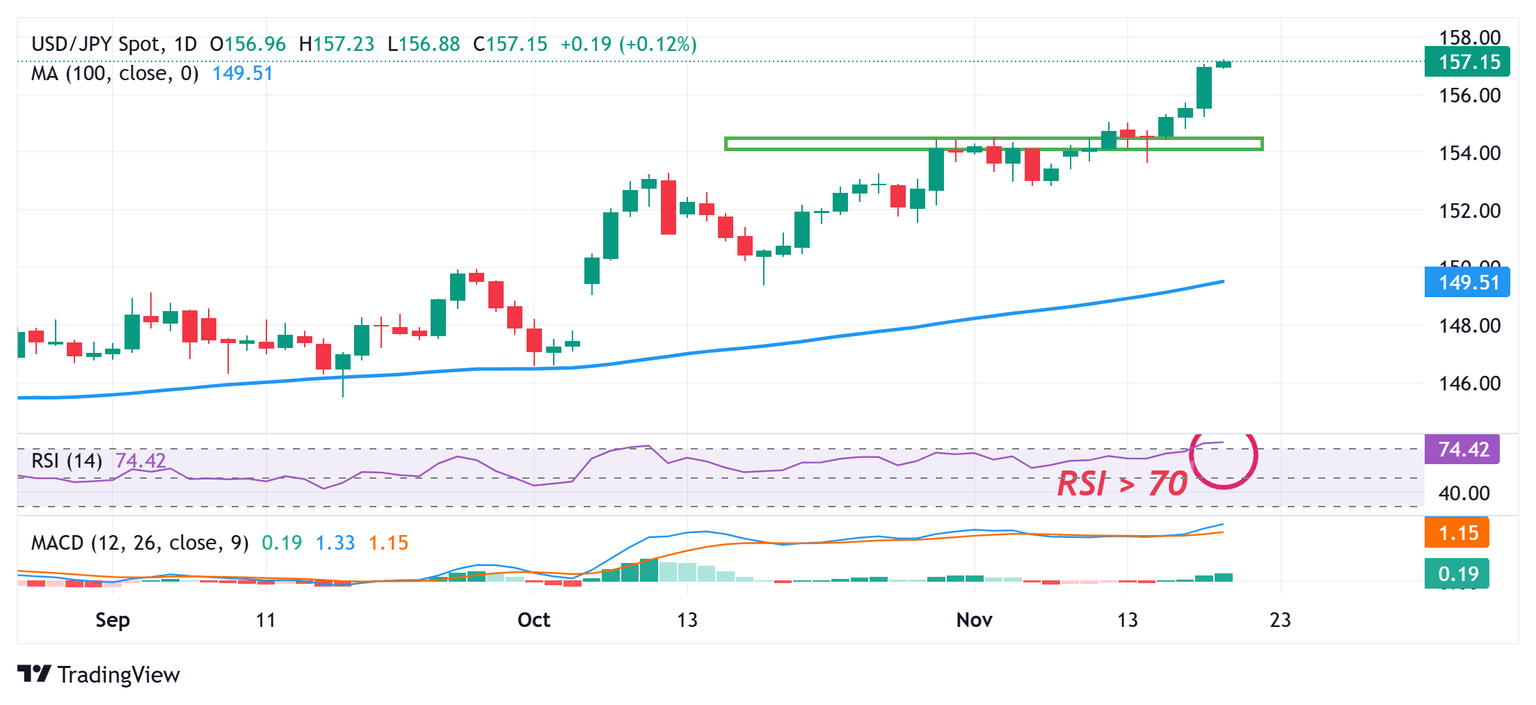
The daily Relative Strength Index (RSI) is showing slight overbought conditions and is preventing traders from placing new bullish bets around the USD/JPY pair. Therefore, it would be wise to wait for some near-term consolidation or a modest pullback before positioning for any further upward movement.
However, any corrective decline may now find good support near the 156.65-156.60 area, below which USD/JPY could extend the decline towards the 156.00 mark. The latter should serve as a pivot point, and continued weakness below could trigger some technical selling, which would set the stage for deeper losses.
On the flip side, the 157.40-157.45 area could act as an immediate hurdle, above which USD/JPY could accelerate momentum towards reclaiming the round figure of 158.00. The next relevant resistance is near the mid-158.00 areas before spot prices aim to test the January swing highs, around the 159.00 area.
Economic indicator
Nonfarm payrolls
The Nonfarm Payrolls release shows the number of new jobs created in the United States during the previous month at all nonfarm businesses. Released by US Bureau of Labor Statistics (Plus). Monthly changes in payroll can be very volatile. The number is also subject to strong revisions, which can also create fluctuations in the Forex board. In general, a high reading is considered bullish for the US Dollar (USD), while a low reading is considered bearish, although revisions to the previous months and the unemployment rate are just as important as the headline number. Therefore, the market reaction depends on how the market evaluates all the data in the BLS report as a whole.
Read more.
Next release:
Thursday 20 November 2025 at 1:30
repetition:
monthly
consensus:
50 thousand
former:
22 k
source:
US Bureau of Labor Statistics
The monthly jobs report in America is considered the most important economic indicator for Forex traders. The change in the number of jobs, released on the first Friday of the month, is closely linked to the overall performance of the economy and is monitored by policymakers. Full employment is one of the powers of the Fed and it takes into account developments in the labor market when setting its policies, thus affecting currencies. Although there are several key indicators that make up estimates, the Non-Farm Payrolls report tends to surprise markets and trigger significant volatility. Actual numbers that beat consensus tend to be bullish for the US dollar.