Silver (XAG/USD) rose further on Monday and is on track to rise 15% over the past six trading days, having reached new highs at $57.88. Market expectations that the Federal Reserve (Fed) will further ease monetary policy next week and a moderate risk-off mood are boosting precious metals.
US macroeconomic data released after the US government shutdown and dovish comments by Federal Reserve officials boosted market expectations for a quarter-point interest rate cut after the November 10 meeting. Aside from that, rumors that White House economic adviser Kevin Hassett will replace Jerome Powell as the new Fed chief are fueling expectations of more interest rate cuts next year.
Technical Analysis: The next resistance is located at $58.00 and $60.00
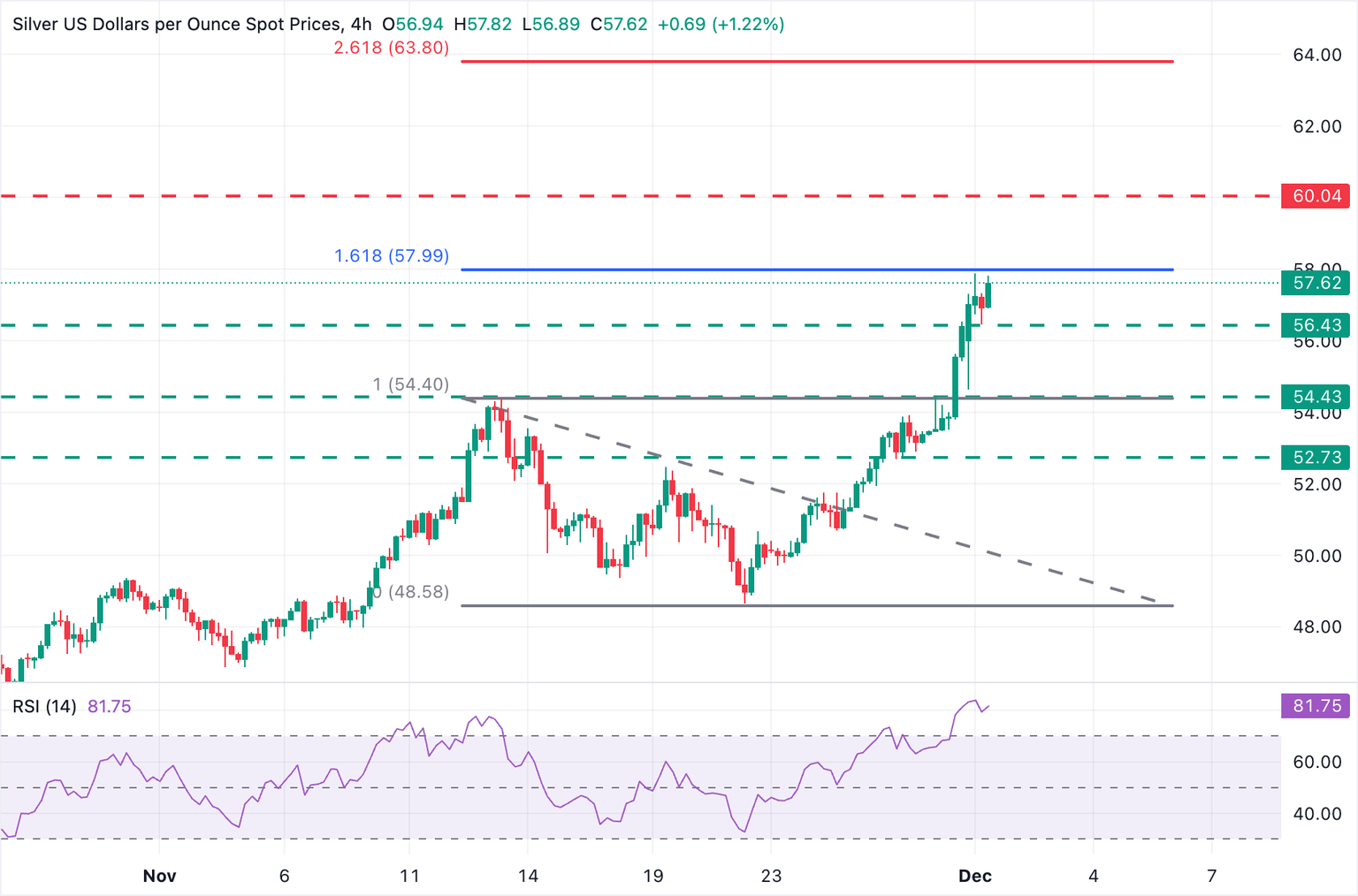
The technical picture remains positive, although the Relative Strength Index (RSI) has reached overbought levels on most time frames, which should serve as a warning to buyers. The 4-hour RSI is above 80.0, indicating the possibility of a correction, but the fundamental backdrop supports speculative demand for precious metals.
Immediate resistance lies at the 161.8% retracement of the mid-November decline, near $58.00. Above here, the next upside target would be the $60.00 psychological level. The 261.8 Fibonacci retracement level of the mentioned session is located at $63.80.
On the downside, intraday support is located at $56.45. A bearish reaction below this level could see support at the previous record high, in the $54.45 area (November 13 high), before the November 27 high, at $52.75.
Frequently asked questions about silver
Silver is a precious metal that is widely traded among investors. It has been used historically as a store of value and medium of exchange. Although less popular than gold, traders may turn to silver to diversify their investment portfolio, for its intrinsic value or as a potential hedge during periods of high inflation. Investors can buy physical silver, in the form of coins or bullion, or trade it through instruments such as exchange-traded funds, which track its price in international markets.
Silver prices can move due to a wide range of factors. Geopolitical instability or fears of a deep recession could cause the price of silver to rise due to its safe-haven status, although to a lesser extent than the price of gold. As a non-yielding asset, silver tends to rise as interest rates fall. Its movements also depend on how the US dollar (USD) behaves as the asset is priced in dollars (XAG/USD). A strong dollar tends to keep the price of silver at bay, while a weak dollar is likely to push prices higher. Other factors such as investment demand, mining supplies – silver is more plentiful than gold – and recycling rates can also influence prices.
Silver is widely used in industry, especially in sectors such as electronics or solar energy, as it has one of the highest electrical conductivity of all metals – more than copper and gold. A rise in demand can cause prices to rise, while a fall tends to bring them down. Dynamics in the economies of the United States, China and India can also contribute to price fluctuations: for the United States, and especially China, its large industrial sectors use silver in various processes; In India, consumer demand for the precious metal used in jewelery also plays a major role in determining prices.
Silver prices tend to follow gold movements. When gold prices rise, silver usually follows suit, as its status as a safe haven asset is similar. The gold/silver ratio, which shows how many ounces of silver are needed to equal the value of one ounce of gold, may help determine the relative valuation between the two metals. Some investors may consider a high ratio to be an indication that silver is undervalued, or that gold is undervalued. Conversely, a low ratio may indicate that gold is undervalued compared to silver.