
The EUR/USD pair gave up previous gains during the European session on Friday and is practically flat on the daily chart, trading at 1.1647 at the time of writing. However, bearish attempts remain contained as investors prepare for a quarter-point interest rate cut by the Federal Reserve next week, while focus now turns to the US Personal Consumption Expenditures (PCE) price index report, due later today.
Data released earlier on Friday revealed that euro zone GDP grew at a rate of 0.3% in the third quarter, higher than the 0.2% growth reported in the previous estimate and also higher than the 0.1% expansion seen in the previous quarter. Annual GDP was left unadjusted at 1.4%, down from 1.5% in the previous quarter.
Furthermore, Eurostat data revealed that employment growth accelerated to 0.2% in the three months to September, from 0.1% in the second quarter, beating expectations for 0.1% growth. On an annual basis, employment in the euro area rose by 0.6%, after a 0.5% increase in the previous quarter and market expectations of steady growth of 0.5%. The impact of these numbers on the euro was marginal.
The focus now turns to the US Personal Consumption Expenditures Price Index, the last measure of inflation before the Federal Reserve’s monetary policy meeting next week. Personal consumption expenditures data is expected to confirm that inflation remains above the Fed’s 2% target, although it is unlikely to change the view that the Fed will ease monetary policy further next week.
Euro price today
The table below shows the percentage change of the Euro (EUR) against the major currencies listed today. The euro was the strongest against the Japanese yen.
| US dollars | euro | GBP | JPY | Canadian | Australian dollar | New Zealand dollar | Swiss franc | |
|---|---|---|---|---|---|---|---|---|
| US dollars | -0.03% | -0.09% | 0.06% | -0.10% | -0.32% | -0.12% | -0.04% | |
| euro | 0.03% | -0.07% | 0.05% | -0.08% | -0.30% | -0.10% | -0.02% | |
| GBP | 0.09% | 0.07% | 0.12% | -0.00% | -0.23% | -0.03% | 0.05% | |
| JPY | -0.06% | -0.05% | -0.12% | -0.14% | -0.37% | -0.18% | -0.09% | |
| Canadian | 0.10% | 0.08% | 0.00% | 0.14% | -0.23% | -0.04% | 0.06% | |
| Australian dollar | 0.32% | 0.30% | 0.23% | 0.37% | 0.23% | 0.20% | 0.28% | |
| New Zealand dollar | 0.12% | 0.10% | 0.03% | 0.18% | 0.04% | -0.20% | 0.08% | |
| Swiss franc | 0.04% | 0.02% | -0.05% | 0.09% | -0.06% | -0.28% | -0.08% |
The heat map shows the percentage changes in major currencies versus each other. The base currency is chosen from the left column, while the counter currency is chosen from the top row. For example, if you select EUR from the left column and move along the horizontal line to USD, the percentage change displayed in the box will represent EUR (base)/USD (quote).
Daily Summary Market Drivers: US Dollar remains on the defensive amid Fed cut hopes
- The US dollar remains the worst performer among the G8 currencies this week. The downbeat ADP employment change report seen earlier this week raised hopes that the Fed will cut interest rates next week, while in Europe, manufacturing activity data beat expectations, providing additional support to the euro.
- On Thursday, euro zone retail sales disappointed with 0% growth in October, falling short of market expectations of 0.1% growth. Data for September was revised to a rise of 0.1% from a previously expected decline of 0.1%. The euro fell after the release, only to rise shortly afterwards.
- Initial unemployment claims in the United States fell to 191,000 in the last week of November, the lowest level in three years, from 218,00 the previous week. The market treated these numbers with caution, as job seekers may have left their unemployment claims pending over the Thanksgiving holiday.
- Futures markets expect an 87% chance of a 25 basis point Fed rate cut at its December 10 meeting, and between two and three more cuts next year, according to CME Group’s Fedwatch tool.
- News about the possible appointment of White House Economic Advisor Kevin Hassett to replace Jerome Powell as the next Chairman of the Federal Reserve also weighs on the US dollar. Bond investors have complained to the US Treasury Department, fearing that Hassett may continue an aggressive easing cycle, the Financial Times reported.
- Later in the day, the US PCE Price Index is expected to confirm that inflation remains steady, with the headline reading accelerating to a 2.8% annualized reading, from 2.7% in August, and the core reading growing at a steady annual pace of 2.9%.
Technical analysis: EUR/USD bulls remain stalled below 1.1680
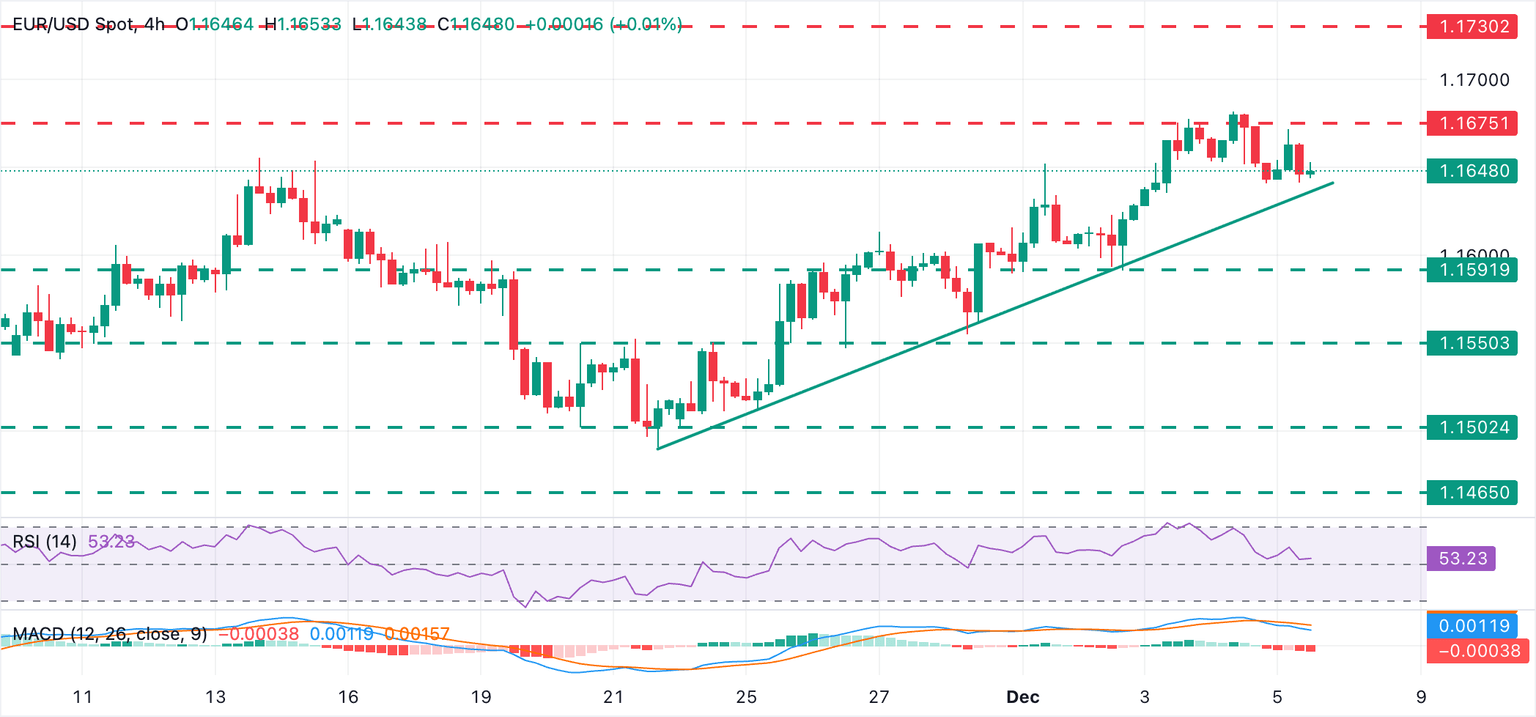
EUR/USD keeps its immediate uptrend intact, with downside attempts contained above trendline support, now at 1.1630, while the 1.1670-1.1680 area keeps the upward move stable. The 4-hour RSI remains steady above 50, currently at 61, although the Moving Average Convergence Divergence (MACD) has pulled back below zero, indicating that the uptrend is losing steam.
The bulls need to break through Thursday’s high at 1.1682 to extend their rally towards the October 17 high, near 1.1730, before the October 1 high at 1.1778.
Conversely, a bearish reaction below the mentioned 1.1630 level may attract bears to retest the weekly lows near 1.1590. In case of further decline, the lows of November 26-28 in the 1.1550-1.1555 area appear as next targets.
Economic indicator
Personal consumption expenditures – price index (annual)
The Personal Consumption Expenditures (PCE) report, which is issued by the US Bureau of Economic Analysis on a monthly basis, measures changes in the prices of goods and services purchased by consumers in the United States. The annual reading compares prices in the reference month to the previous year. Price changes may cause consumers to switch from purchasing one good to another and the personal consumption expenditures deflator can take such substitutions into account. This makes it the Fed’s preferred measure of inflation. In general, a high reading is considered bullish for the US Dollar (USD), while a low reading is considered bearish.
Read more.
Next release:
Friday 05 December 2025 at 13:30
repetition:
monthly
consensus:
2.8%
former:
2.7%
source:
US Bureau of Economic Analysis
Economic indicator
Core Personal Consumption Expenditures – Price Index (annual)
Core personal consumption expenditures (PCE), issued by US Bureau of Economic Analysis On a monthly basis, it measures changes in the prices of goods and services purchased by consumers in the United States. The Personal Consumption Expenditures Price Index is also the Fed’s preferred measure of inflation. The annual reading compares commodity prices in the reference month with the same month of the previous year. The core reading excludes the more volatile so-called food and energy components to give a more accurate measure of price pressures.
Read more.
Next release:
Friday 05 December 2025 at 13:30
repetition:
monthly
consensus:
2.9%
former:
2.9%
source:
US Bureau of Economic Analysis
Following the publication of the GDP report, the US Bureau of Economic Analysis releases personal consumption expenditures (PCE) price index data along with monthly changes in personal spending and personal income. Policymakers at the Federal Open Market Committee use the core annual personal consumption expenditures price index, which excludes volatile food and energy prices, as their main measure of inflation. A stronger than expected reading may help the US dollar outperform its rivals, as this may indicate a possible hawkish shift in the Fed’s future guidance and vice versa.