
The EUR/USD pair gave up most of the gains made in the early European session on Wednesday and is trading at the 1.1630 area, after being rejected at session highs near 1.1660. Investors looked on from the sidelines, awaiting the US Federal Reserve’s monetary policy decision scheduled for later in the day.
The market has practically ruled out a 25 basis point rate cut from the Fed later Wednesday, and the MPC is likely to show the widest divergence in years. In this context, expectations of interest rate cuts by the central bank, the so-called “dot plot,” and the tone of the ensuing press conference by Chairman Jerome Powell will be the main market movers.
On the macroeconomic data front, the release of delayed US JOLTS employment numbers for September and October was a positive surprise, which, coupled with the flat PCE inflation numbers seen last week, adds to the case for a “tightening” by the Fed.
However, US President Donald Trump invited himself to the party on Tuesday, renewing his pressure for sharp interest rate cuts, in an interview with Politico, although the impact on the US dollar was minimal.
Euro price today
The table below shows the percentage change of the Euro (EUR) against the major currencies listed today. The euro was the strongest against the Canadian dollar.
| US dollars | euro | GBP | JPY | Canadian | Australian dollar | New Zealand dollar | Swiss franc | |
|---|---|---|---|---|---|---|---|---|
| US dollars | -0.05% | -0.06% | -0.11% | 0.03% | -0.10% | -0.04% | -0.09% | |
| euro | 0.05% | -0.01% | -0.09% | 0.08% | -0.05% | 0.00% | -0.04% | |
| GBP | 0.06% | 0.00% | -0.06% | 0.08% | -0.04% | 0.01% | -0.03% | |
| JPY | 0.11% | 0.09% | 0.06% | 0.15% | 0.02% | 0.07% | 0.03% | |
| Canadian | -0.03% | -0.08% | -0.08% | -0.15% | -0.13% | -0.08% | -0.11% | |
| Australian dollar | 0.10% | 0.05% | 0.04% | -0.02% | 0.13% | 0.05% | 0.00% | |
| New Zealand dollar | 0.04% | -0.01% | -0.01% | -0.07% | 0.08% | -0.05% | -0.05% | |
| Swiss franc | 0.09% | 0.04% | 0.03% | -0.03% | 0.11% | -0.01% | 0.05% |
The heat map shows the percentage changes in major currencies versus each other. The base currency is chosen from the left column, while the counter currency is chosen from the top row. For example, if you select EUR from the left column and move along the horizontal line to USD, the percentage change displayed in the box will represent EUR (base)/USD (quote).
Daily summary of market drivers: Range-bound trading ahead of Fed
- The US Dollar (USD) fell on Wednesday, after rising over the past two days. However, price action remains within recent ranges, with traders awaiting the outcome of the Federal Reserve’s monetary policy meeting to make investment decisions.
- The Fed is widely expected to cut its repo rate by 25 basis points to the 3.50-3.75% range, but Chairman Jerome Powell may signal a pause in monetary easing in the coming months and warn of upside risks to inflation.
- Investors will also be paying attention to the bank’s interest rate forecasts, which will contrast with market expectations of two or three more rate cuts in 2026.
- US President Trump increased pressure on the Fed in an interview with Politico newspaper published on Tuesday, describing Powell as “not a smart person” for not lowering borrowing costs faster, and asserting that support for “an immediate cut in interest rates” would be a test to elect the next Fed chair.
- White House economist Kevin Hassett, who is also the top candidate to replace Powell at the Fed, stressed that there was “plenty of room” to ease monetary policy further, although he acknowledged that the situation could change if inflationary pressures rise.
- Meanwhile, late figures from the US Department of Labor revealed that job openings rose to 7.658 million in September and to 7.67 million in October, from 7.227 million in August, beating market expectations for a slight decline to 7.2 million.
- In Europe, European Central Bank President Christine Lagarde stuck to her usual tone, stressing that the bank’s monetary policy remains in good shape and suggesting that she may raise growth forecasts for the region again, adding to evidence that the easing cycle has come to an end.
Technical analysis: EUR/USD remains stalled below previous trend line support
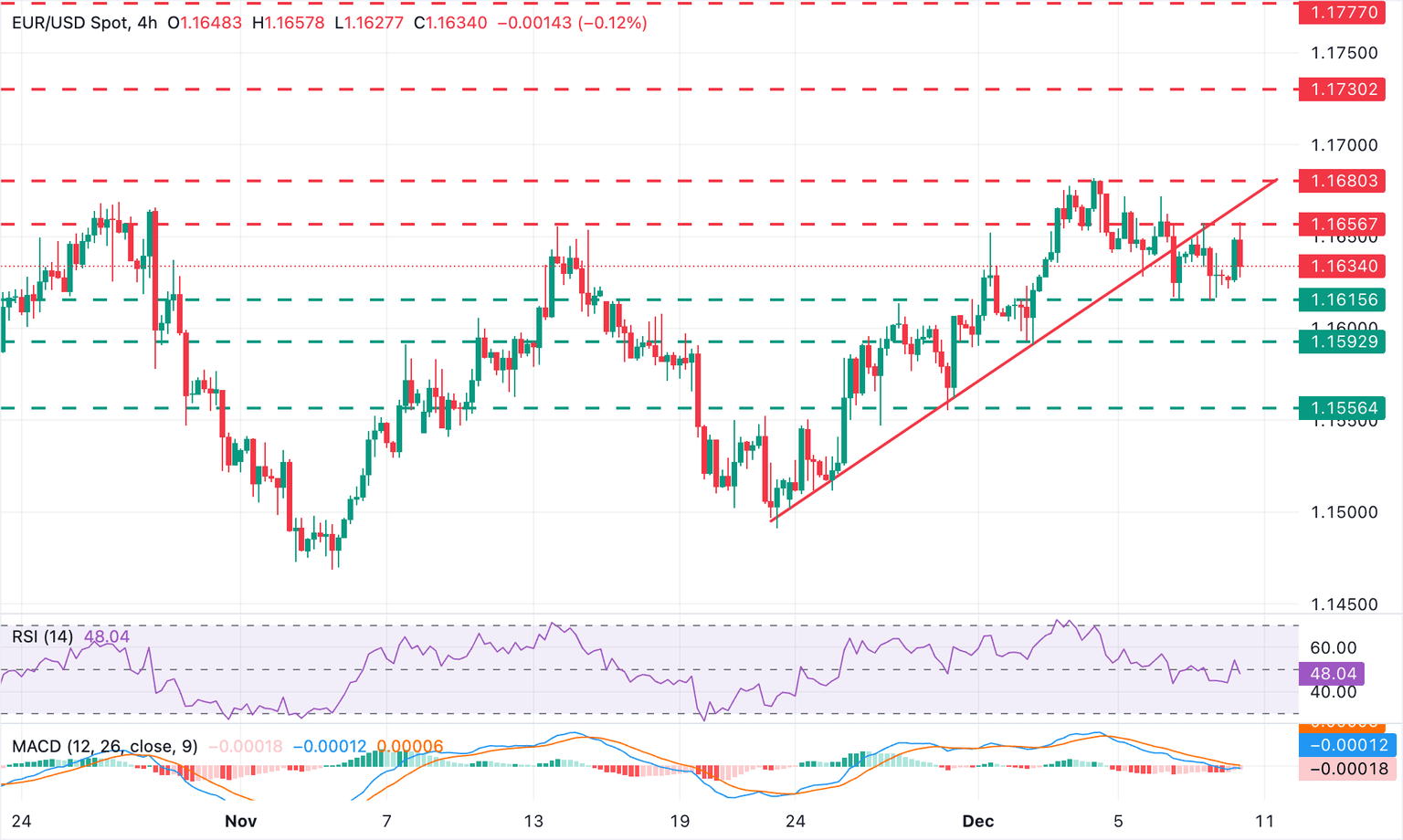
Technically, the EUR/USD pair broke below the uptrend line from the November 20 lows and is still unable to return above it, which is a bearish signal. Oscillators are also pointing down. The 4-hour Moving Average Convergence Divergence (MACD) remains below zero, highlighting moderate bearish momentum, although the 4-hour Relative Strength Index (RSI) has returned to levels just above the 50 line.
The bullish move remains capped below Tuesday’s high, at 1.1657, and the reversal trend line, now at the 1.1665 area, which closes the way to last week’s high, at 1.1682, and the October 17 high, near 1.1730. On the downside, immediate support lies at Tuesday’s low at 1.1615, ahead of the December 1-2 lows around 1.1590 and the November 26-28 lows in the 1.1550-1.1555 area.
Economic indicator
Federal interest rate decision
the Federal Reserve The Federal Reserve deliberates on monetary policy and decides on interest rates at eight pre-scheduled meetings annually. It has two mandates: keeping the inflation rate at 2%, and maintaining full employment. Its main tool for achieving this end is setting interest rates – at which banks lend and banks lend to each other. If it decides to raise interest rates, the US dollar (USD) tends to strengthen because it attracts more foreign capital inflows. If they lower interest rates, they tend to weaken the US dollar while draining capital to countries that offer higher returns. If interest rates are left unchanged, attention turns to the tone of the FOMC statement, and whether it is hawkish (expecting interest rates to rise in the future), or dovish (expecting interest rates to fall in the future).
Read more.
Next release:
Wednesday 10 December 2025 at 19:00
repetition:
irregular
consensus:
3.75%
former:
4%
source:
Federal Reserve
Economic indicator
Interest rate forecasts – first year
At four of its eight scheduled meetings, the Federal Reserve Bank (Fed) issues a Summary of economic forecastsOr a “dot chart”. This shows each member of the Federal Open Market Committee (FOMC) on where they expect the federal funds rate (the interest rate at which banks lend to each other) to go in the future. It can have a significant impact on the US Dollar (USD), especially if members change their forecasts. It is widely used as a guide to the final price and likely timing of a policy pivot.
Read more.
Next release:
Wednesday 10 December 2025 at 19:00
repetition:
irregular
consensus:
–
former:
3.4%
source:
Federal Reserve