
EUR/USD is rising ahead of the US session open on Monday, trading above 1.1750 at the time of writing, with last week’s high of 1.1762, just a short distance away. The pair was boosted by an unexpectedly strong release of industrial production in the euro zone, which improved the market mood, ahead of the release of manufacturing data in New York and some speeches from Federal Reserve officials scheduled for later today.
Data released by Eurostat earlier on Monday revealed that factory output growth in the region accelerated to a pace of 0.8% in November, from 0.2% in October, beating expectations for 0.1% growth. On an annual basis, industrial production increased by 2%, compared to 1.2% growth in October.
From a broader perspective, the EUR/USD pair continues to consolidate its gains after rising almost 2% over the past three weeks. Investors’ bets on further interest rate cuts by the US Federal Reserve and the possible replacement of Chairman Jerome Powell with a more pessimistic chairman keep US bullish attempts limited for now.
However, traders are maintaining a cautious mood, reluctant to take excessive risks ahead of key macroeconomic releases later this week, namely delayed US non-farm payrolls (NFP) reports for October and November on Tuesday, and the November Consumer Price Index (CPI) on Thursday. In between, the European Central Bank will issue its monetary policy decision on Thursday as well.
Euro price today
The table below shows the percentage change of the Euro (EUR) against the major currencies listed today. The euro was the strongest against the New Zealand dollar.
| US dollars | euro | GBP | JPY | Canadian | Australian dollar | New Zealand dollar | Swiss franc | |
|---|---|---|---|---|---|---|---|---|
| US dollars | -0.12% | -0.15% | -0.48% | -0.07% | -0.02% | 0.14% | -0.02% | |
| euro | 0.12% | -0.04% | -0.36% | 0.04% | 0.10% | 0.26% | 0.10% | |
| GBP | 0.15% | 0.04% | -0.31% | 0.08% | 0.14% | 0.31% | 0.14% | |
| JPY | 0.48% | 0.36% | 0.31% | 0.42% | 0.48% | 0.64% | 0.48% | |
| Canadian | 0.07% | -0.04% | -0.08% | -0.42% | 0.06% | 0.22% | 0.06% | |
| Australian dollar | 0.02% | -0.10% | -0.14% | -0.48% | -0.06% | 0.17% | -0.02% | |
| New Zealand dollar | -0.14% | -0.26% | -0.31% | -0.64% | -0.22% | -0.17% | -0.16% | |
| Swiss franc | 0.02% | -0.10% | -0.14% | -0.48% | -0.06% | 0.02% | 0.16% |
The heat map shows the percentage changes in major currencies versus each other. The base currency is chosen from the left column, while the counter currency is chosen from the top row. For example, if you select EUR from the left column and move along the horizontal line to USD, the percentage change displayed in the box will represent EUR (base)/USD (quote).
Daily Summary Market Movers: Monetary policy divergence supports the euro
- The euro held most of the gains of the past three weeks on Monday, supported by the divergence in monetary policy between the European Central Bank and the Federal Reserve. The Federal Reserve is expected to cut interest rates at least once in 2026, while the European Central Bank has indicated that the next change in monetary policy could be to raise interest rates.
- President Trump said Friday in an interview that former Federal Reserve Governor Kevin Warsh is the best candidate to replace Chairman Powell at the end of his term in May. Trump has also mentioned White House economist Kevin Hassett as a candidate for the position. The president also said the next central bank chief should listen to his opinion when setting the future direction of interest rates.
- Data out of China earlier on Monday revealed that industrial production slowed versus expectations in November, while retail consumption grew at its lowest pace in nearly two years. These numbers renewed concerns about the health of the world’s second-largest economy and weakened risk appetite during the Asian session.
- Also in China, news that state-backed property developer China Vanke is struggling to find a way to avoid bankruptcy has put concerns about the country’s real estate sector back on the table, worsening market sentiment.
- In the United States, the Empire State Manufacturing Index in New York is expected to fall to 10.6 in December from 18.7 the previous month. Next, Fed Governor Stephen Meiran and New York Fed President John Williams will appear in public and may provide more clues about the central bank’s monetary policy plans.
Technical analysis: EUR/USD extends gains after sharp rise
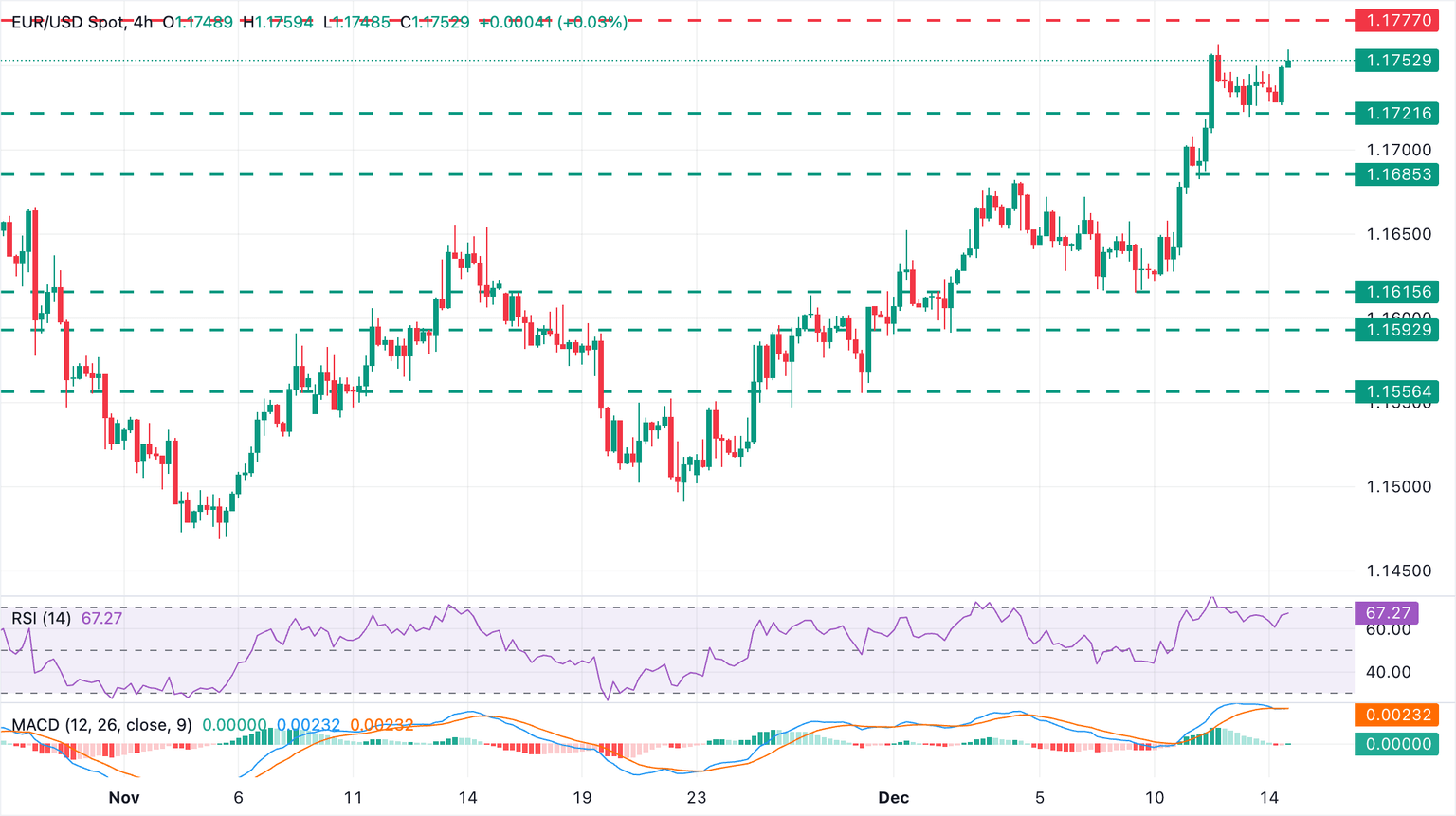
The EUR/USD pair is trading within recent ranges, below the multi-month high of 1.1762 hit last week. This consolidation phase allows the 4-hour RSI to pull back from the overbought zone, but it still stands at levels consistent with a strong uptrend. However, the Moving Average Convergence Divergence (MACD) indicator is showing an impending bearish crossover, indicating that further correction may be ahead.
Immediate support is at the December 12 low, near 1.1720. Furthermore, Thursday’s low at 1.1680 and December 9’s low at 1.1615 will be in focus. On the upside, the December 11 high at 1.1762 and October 1 high at around 1.1780 are likely to challenge bulls. In case of a further rise, the target is the highs of September 23 and 24 near 1.1820.
Economic indicator
New York Empire State Manufacturing Index
Empire State Manufacturing Survey conducted by Federal Reserve Bank of New York Measures working conditions for manufacturers in New York. In general, a positive result indicates an upward trend for the US dollar, while a negative result indicates weak US dollar growth.
Read more.
Latest version:
Monday 17 November 2025 at 1:30
repetition:
monthly
actual:
18.7
consensus:
6
former:
10.7
source:
Federal Reserve Bank of New York

