The price of gold (XAU/USD) fell below $4,350 during early European trading hours on Thursday. The precious metal is pulling back from seven-week highs amid some profit-taking and a rebound in the US dollar (USD). The potential downside for the yellow metal may be limited after recent US jobs data boosted market expectations of further interest rate cuts by the US Federal Reserve and pulled the US dollar lower. Lower interest rates can reduce the opportunity cost of holding gold, supporting the non-yielding precious metal.
Furthermore, geopolitical tensions escalated after Venezuela deployed its navy to escort oil ships amid threats of a US blockade. This, in turn, could boost the price of gold because it is considered a traditional safe haven asset.
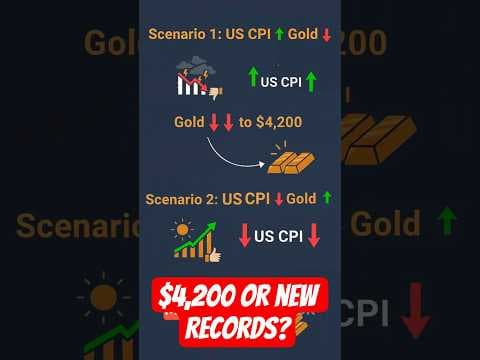
Traders are preparing for the release of US CPI inflation data, which will be published later on Thursday. The headline CPI is expected to show a 3.1% y/y rise in November, while the core CPI is expected to show a 3.0% y/y increase over the same period. Also, US weekly initial jobless claims will be released later today.
Daily Summary Market Drivers: Gold drifts lower amid profit taking ahead of key CPI report
- The Venezuelan government has ordered its navy to escort ships carrying petroleum products from its port, escalating the risk of confrontation with the United States after President Donald Trump ordered a “blockade” targeting the country’s oil industry.
- Trump spoke in a national address early Thursday, saying the next head of the Fed will be someone who believes in cutting interest rates “significantly.” He also indicated that he would soon announce a successor to current Fed Chairman Jerome Powell.
- “This November’s CPI could represent a period that more closely reflects holiday season sales than a typical November, which would reflect average prices throughout the entire month,” said Veronica Clark, an economist at Citigroup. “If there is some abnormal weakness in commodity prices in November, it is possible that there will be a greater recovery in these components in December.”
- Federal Reserve Governor Christopher Waller on Wednesday supported further interest rate cuts to return the central bank to neutral, according to Bloomberg. However, Waller also warned that there was no need to rush amid rising inflation.
- Atlanta Fed President Rafael Bostic said Tuesday he did not support cutting interest rates last week and sees no justification for cutting rates next year unless inflation declines.
- The US Bureau of Labor Statistics (BLS) revealed on Tuesday that the non-farm payrolls (NFP) report rose by 64,000 in November after falling by 105,000 in October. The US unemployment rate rose to 4.6% in November from 4.4% in October.
- Federal funds rate futures are now priced at a 31% probability that the Fed will cut interest rates next month after the nonfarm payrolls report, compared with 22% just before that, according to LSEG estimates.
Gold carries a positive technical bias in the long term
Gold is trading negatively during the day. According to the four-hour chart, the precious metal maintains a constructive outlook, with the price holding above the key 100-day EMA. The path of least resistance is to the upside with the Bollinger Bands widening and the 14-day RSI lying above its midline, indicating that further upside looks appropriate.
If green candles appear and momentum builds above the upper Bollinger band border at $4,352, the XAU/USD pair could be poised for another rally at the all-time high at $4,381, on its way to the psychological mark of $4,400.
On the other hand, if the pair prints more red candles and remains below the December 17 low at $4,300, this could attract sellers towards the December 16 low at $4,271. An additional downside candidate to watch is the 100-day moving average of $4,233.
-1766041097941-1766041097946.png&w=1536&q=95)
Frequently asked questions about gold
Gold has played a major role in human history as it has been widely used as a store of value and a medium of exchange. Currently, apart from its luster and use in jewellery, the precious metal is widely viewed as a safe haven asset, meaning it is a good investment during turbulent times. Gold is also widely viewed as a hedge against inflation and currency depreciation because it is not dependent on any specific issuer or government.
Central banks are the largest holders of gold. In their aim to support their currencies in turbulent times, central banks tend to diversify their reserves and purchase gold to improve the perceived strength of the economy and the currency. High gold reserves can be a source of confidence for a country’s solvency. Central banks added 1,136 tons of gold worth about $70 billion to their reserves in 2022, according to data from the World Gold Council. This is the highest annual purchase since records began. Central banks in emerging economies such as China, India and Turkey are rapidly increasing their gold reserves.
Gold has an inverse relationship with the US dollar and US Treasuries, which are major reserve assets and safe havens. When the value of the dollar declines, gold tends to rise, enabling investors and central banks to diversify their assets in turbulent times. Gold is also inversely correlated with risk assets. A rise in the stock market tends to weaken the price of gold, while a sell-off in riskier markets tends to favor the precious metal.
The price can move due to a wide range of factors. Geopolitical instability or fears of a deep recession could cause the price of gold to rise rapidly due to its safe-haven status. As a lower-yielding asset, gold tends to rise as interest rates fall, while a higher cost of money usually negatively impacts the yellow metal. However, most of the moves depend on how the US Dollar (USD) behaves as the asset is priced in Dollars (XAU/USD). A stronger dollar tends to keep the price of gold in check, while a weaker dollar is likely to push gold prices higher.