
The Japanese Yen (JPY) adds further losses during the day following opening remarks by Bank of Japan (BoJ) Governor Kazuo Ueda in the post-meeting press conference. Ueda said loose monetary policy will support the economic recovery, and real interest rates are expected to remain at significantly low levels. Policymakers had previously indicated that Friday’s rate hike should be seen as part of a gradual and cautious process rather than a shift toward restrictive policy. This increases market bets on further interest rate hikes by the Bank of Japan in 2026 and weighs heavily on the Japanese yen.
Aside from this, the generally positive tone around stock markets has turned out to be another factor affecting the Japanese yen’s safe haven status. Meanwhile, the initial market reaction to weak US consumer inflation numbers on Thursday turned out to be short-lived as the numbers were likely distorted against the backdrop of the longest US government shutdown on record. This in turn helps the US dollar attract buyers for the third day in a row and return closer to the weekly high, contributing to the momentum of the USD/JPY pair near the mid-156.00 areas. However, the US Federal Reserve’s dovish outlook could act as a headwind for the US dollar and provide some support to the low-yielding Japanese yen.
JPY bulls are in control in the absence of new hawkish signals from the Bank of Japan
- Board members of the Bank of Japan (BoJ) decided to raise the short-term interest rate by 25 basis points to 0.75%, or the highest level in 30 years, after concluding a two-day policy meeting on Friday. This move was almost entirely priced into the markets and failed to strengthen the Japanese yen.
- In an accompanying policy statement, the Bank of Japan said it would continue to raise interest rates if the economy and prices move in line with expectations. Policymakers added that the likelihood of achieving the baseline scenario was rising, although they did not provide indications about the future policy path.
- Bank of Japan Governor Kazuo Ueda said during the press conference that followed the meeting that the Japanese economy is recovering moderately, albeit with some weakness. Ueda added that the central bank will look closely at the impact of the recent interest rate change and the pace of monetary adjustment will depend on the economic, financial and price outlook.
- Earlier today, Japan’s Statistics Bureau reported that the national consumer price index rose 2.9% year-on-year in November, down slightly from 3.0% the previous month. Further details revealed that the core measure, which excludes volatile fresh food prices, remained steady at 3%, as expected.
- Meanwhile, the core CPI that excludes fresh food and energy prices, which the Bank of Japan closely monitors as a measure of core inflation, fell from 3.1% to 3% in November. However, inflation in Japan has remained steady and well above the central bank’s annual target of 2%.
- However, JPY bulls appear to be hesitant and are choosing to wait for signs that the Bank of Japan is willing to tighten further before placing new bets. Hence, the focus will remain on BOJ Governor Kazuo Ueda’s comments, which in turn should play a major role in influencing the JPY price dynamics.
- The recent sharp rise in Japanese government bonds – led by public debt of about 250% of GDP, the highest in the world – continues to fuel concerns about Japan’s deteriorating fiscal health amid Prime Minister Sanae Takaishi’s massive spending plan. This appears to be undermining the Japanese yen.
- From the United States, the Bureau of Labor Statistics reported on Thursday that the Consumer Price Index rose 2.7% year over year in November versus 3.1% expected. Moreover, the core CPI, which excludes volatile food and energy prices, missed estimates and rose 2.6% last month.
- The data suggests that inflationary pressures may ease enough for the US Federal Reserve to ease further. In fact, traders expect the Fed to cut interest rates by 63 basis points in 2026. US President Donald Trump said the next Fed chair will be someone who supports sharply lower interest rates.
- This represents a significant deviation from the Bank of Japan’s hawkish bets and should support the low-yielding Japanese yen. However, the initial market reaction turned out to be short-lived, keeping the US dollar close to the weekly high reached on Thursday and supporting the USD/JPY pair.
- Investors are looking to the US economic docket – which includes existing home sales and the revised University of Michigan Consumer Confidence Index – for some momentum. However, the USD/JPY pair looks set to close almost unchanged for the week, which calls for caution from aggressive traders.
The USD/JPY pair is still on track to rise further towards the monthly peak, around the 157.00 area.
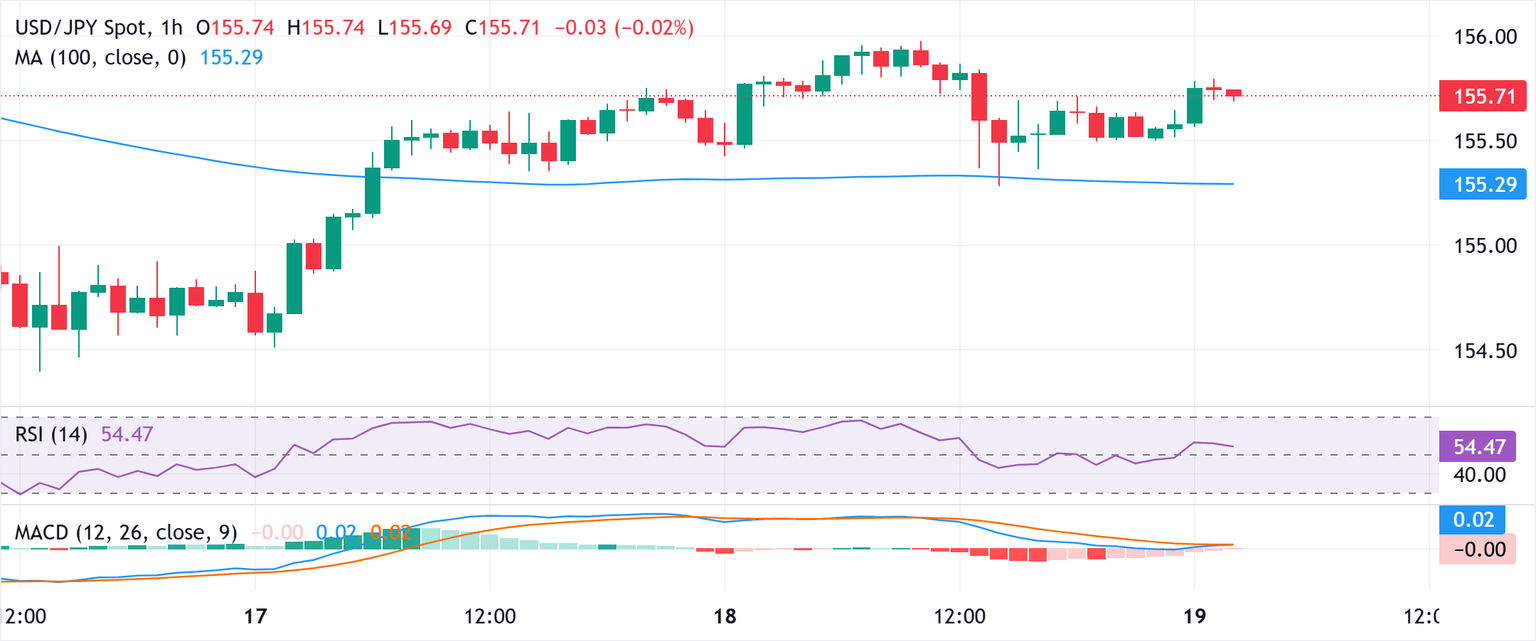
On the back of a breakout of the 100 hourly simple moving average (SMA) this week, sustained strength above the 156.00 mark will be seen as a major catalyst for a USD/JPY rally. Given that the oscillators on the hourly and daily charts are holding in positive territory, spot prices may then aim to test the monthly high, around the 157.00 area, touched last week, with some intermediate hurdle near the 156.55-156.60 area.
On the flip side, the resistance turned support 100-hour SMA, currently located around the 155.30 area, could protect the immediate downside ahead of the 155.00 psychological mark. A convincing break below the latter could trigger some technical selling and pull USD/JPY to the 154.35-154.30 region, or the monthly low touched on December 5. This is followed by the 154.00 mark, which, if broken, may shift the bias in favor of bearish traders.
(This story was corrected on 19 December at 08:45 to say in the first paragraph that policymakers noted a rate hike on Friday, not a rate cut.)
Japanese yen price today
The table below shows how much the Japanese Yen (JPY) has changed against the major currencies listed today. The Japanese yen was the strongest against the New Zealand dollar.
| US dollars | euro | GBP | JPY | Canadian | Australian dollar | New Zealand dollar | Swiss franc | |
|---|---|---|---|---|---|---|---|---|
| US dollars | 0.03% | -0.01% | 0.27% | 0.07% | 0.09% | 0.21% | 0.10% | |
| euro | -0.03% | -0.04% | 0.24% | 0.05% | 0.07% | 0.19% | 0.07% | |
| GBP | 0.01% | 0.04% | 0.29% | 0.09% | 0.11% | 0.23% | 0.11% | |
| JPY | -0.27% | -0.24% | -0.29% | -0.18% | -0.17% | -0.06% | -0.17% | |
| Canadian | -0.07% | -0.05% | -0.09% | 0.18% | 0.01% | 0.12% | 0.02% | |
| Australian dollar | -0.09% | -0.07% | -0.11% | 0.17% | -0.01% | 0.12% | 0.00% | |
| New Zealand dollar | -0.21% | -0.19% | -0.23% | 0.06% | -0.12% | -0.12% | -0.11% | |
| Swiss franc | -0.10% | -0.07% | -0.11% | 0.17% | -0.02% | -0.00% | 0.11% |
The heat map shows the percentage changes in major currencies versus each other. The base currency is chosen from the left column, while the counter currency is chosen from the top row. For example, if you select the Japanese Yen from the left column and move along the horizontal line to the US Dollar, the percentage change displayed in the box will represent the Japanese Yen (base)/US Dollar (quote).