
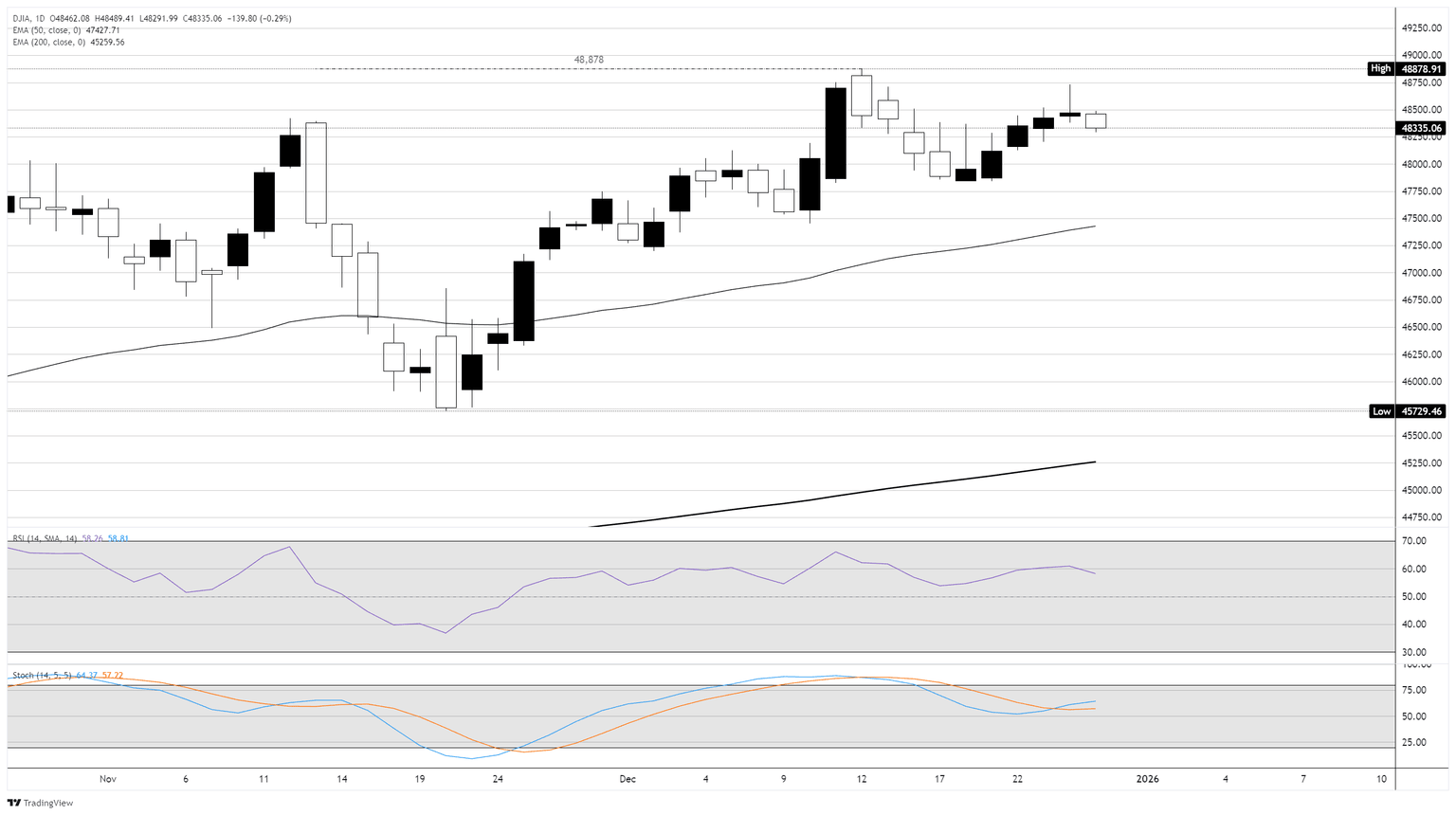
The Dow Jones Industrial Average (DJIA) fell on Tuesday, shedding about 100 points as stocks grappled with holiday-restricted market flows and lower year-end trading volumes. Moderate gains in energy stocks were offset by weakness in the health care and financial services sectors.
Stocks split down the middle, and the Dow Jones falls
The Dow Jones fell nearly 100 points, struggling to hold steady at the 48,400 level, while the S&P 500 and the tech-heavy Nasdaq remained near flat, splitting the middle between gainers and losers for the day. Boeing (BA) rose 1.75% after winning a government contract to build and supply more F-15 fighter jets to Israel, and UnitedHealth Group (UNH) rose 0.75%. Goldman Sachs ( GS ) stock fell 1.2% on Tuesday, serving as a general indicator of year-end risk appetite and throwing up some warning signs for traders engaged in low-volume trades, while biopharma giant Amgen ( AMGN ) fell a similar 1% on the day.
The Federal Reserve’s (Fed) minutes from its final interest rate decision of the year have been released, giving investors confirmation that Federal Open Market Committee (FOMC) voters are willing to play ball on the concept of further interest rate cuts, but revealing little feedback. The Fed is leaning on the dovish side, with the majority of rate setters willing to explore further rate cuts, but the Fed’s policy changes still depend on easing inflation data, not its absence.
Read more: Minutes from the FOMC meeting showed that most officials believe further interest rate cuts would be appropriate
Trump still wants to get rid of Powell early
US President Donald Trump has resumed his administration policy approach of launching tirade against outgoing Federal Reserve Chairman Jerome Powell. During a meeting with Israeli President Benjamin Netanyahu, Trump reiterated his position that Fed Chairman Powell is a “fool” and threatened to sue the Fed chairman for “gross incompetence,” particularly for not lowering interest rates as quickly as Trump personally wanted. Donald Trump appointed Jerome Powell as Chairman of the Federal Reserve during his first term.
Dow Jones daily chart
Dow Jones FAQs
The Dow Jones Industrial Average is one of the oldest stock market indexes in the world, consisting of the 30 most actively traded stocks in the United States. The index is price-weighted and not market capitalization-weighted. It is calculated by summing the component stock prices and dividing them by a factor that currently amounts to 0.152. The index was founded by Charles Dow, who also founded the Wall Street Journal. In later years, it was criticized for not being broadly representative enough because it tracks only 30 conglomerates, unlike broader indices such as the S&P 500.
There are many different factors that drive the Dow Jones Industrial Average (DJIA). The overall performance of the constituent companies disclosed in the company’s quarterly earnings reports is the headline performance. US and global macroeconomic data also contribute to its impact on investor sentiment. The level of interest rates, set by the Federal Reserve (Fed), also affects the Dow Jones Industrial Average because it affects the cost of credit, on which many companies rely heavily. Therefore, inflation can be a key driver along with other metrics that influence the Fed’s decisions.
Dow Theory is a method of determining the fundamental trend of the stock market developed by Charles Dow. The basic step is to compare the trend of the Dow Jones Industrial Average (DJIA) and the Dow Jones Transportation Average (DJTA) and only follow trends where both are moving in the same direction. Size is a confirmatory criterion. The theory uses elements of peak and trough analysis. Dow Theory postulates three phases of a trend: accumulation, when smart money starts buying or selling; Public participation, when the wider public joins in; And distribution, when the smart money comes out.
There are a number of ways to trade the DJIA. The first is the use of ETFs that allow investors to trade the Dow Jones Industrial Average as a single security, rather than having to buy shares in all 30 component companies. A leading example of this is the SPDR Dow Jones Industrial Average ETF (DIA). DJIA futures allow traders to speculate on the future value of an index and options provide the right, but not the obligation, to buy or sell the index at a predetermined price in the future. Mutual funds enable investors to purchase a share of a diversified portfolio of DJIA stocks and thus provide exposure to the overall index.