
The EUR/USD pair recorded marginal losses on Tuesday, trading near 1.1765 at the time of writing amid the current market calm ahead of the New Year holiday. The single currency found support not far from three-month highs at 1.1800, but rising geopolitical tensions are weighing on risk appetite and keeping the euro’s upward attempts limited.
On the other hand, the US dollar is on track to close out its worst annual performance in nearly a decade. The divergence in monetary policy between the European Central Bank, which appears to have reached the end of its easing cycle, and the US Federal Reserve, which is expected to cut interest rates between one and three times next year, is supporting the pair, which shows a rise of around 14% in 2025.
Against this background, the market is waiting for the US Central Bank to release the minutes of its December monetary policy meeting, scheduled at 19:00 GMT. The Fed delivered a widely expected rate cut two weeks ago and signaled 25 basis points for further cuts in 2026, amid a broadly divided Monetary Policy Committee. Moreover, Chairman Jerome Powell will end his term next May and will be replaced by a more pessimistic successor. All things considered, the market is betting on a sharper easing cycle in the US.
Euro price today
The table below shows the percentage change of the Euro (EUR) against the major currencies listed today. The euro was the strongest against the New Zealand dollar.
| US dollars | euro | GBP | JPY | Canadian | Australian dollar | New Zealand dollar | Swiss franc | |
|---|---|---|---|---|---|---|---|---|
| US dollars | 0.04% | 0.00% | -0.08% | 0.05% | -0.16% | 0.07% | -0.00% | |
| euro | -0.04% | -0.03% | -0.11% | 0.01% | -0.21% | 0.04% | -0.02% | |
| GBP | -0.00% | 0.03% | -0.06% | 0.04% | -0.18% | 0.07% | -0.02% | |
| JPY | 0.08% | 0.11% | 0.06% | 0.13% | -0.09% | 0.14% | 0.10% | |
| Canadian | -0.05% | -0.01% | -0.04% | -0.13% | -0.21% | 0.02% | -0.07% | |
| Australian dollar | 0.16% | 0.21% | 0.18% | 0.09% | 0.21% | 0.24% | 0.20% | |
| New Zealand dollar | -0.07% | -0.04% | -0.07% | -0.14% | -0.02% | -0.24% | -0.09% | |
| Swiss franc | 0.00% | 0.02% | 0.02% | -0.10% | 0.07% | -0.20% | 0.09% |
The heat map shows the percentage changes in major currencies versus each other. The base currency is chosen from the left column, while the counter currency is chosen from the top row. For example, if you select EUR from the left column and move along the horizontal line to USD, the percentage change displayed in the box will represent EUR (base)/USD (quote).
Market Drivers in Daily Summary: USD’s upward attempts remain limited
- The Euro (EUR) is rising again after a shallow correction from three-month highs. The pair keeps its broader uptrend intact, with market expectations of further interest rate cuts from the Fed keeping US Treasury yields and the US dollar lower.
- On the geopolitical front, the Russian government announced a review of its negotiating position with Ukraine after it accused Kiev of attacking one of the residences of Russian President Vladimir Putin. The Ukrainian authorities denied these accusations, but the fate of the peace talks became questionable.
- In Asia, China is conducting military exercises around the island of Taiwan, which are expected to continue on Tuesday. These maneuvers came a few days after the United States announced an agreement to send an arms package worth $11 billion to the island, representing an escalation of tensions in an already turbulent region.
- If that wasn’t enough, US President Donald Trump has threatened to launch another attack on Iran if the Islamic Republic tries to rebuild its nuclear weapons program. These threats have so far had a limited impact on FX markets, but rising geopolitical risks in the world’s hottest regions are likely to keep risk appetite low and limit the euro’s bullish attempts.
- Spain’s consolidated consumer price index fell to an annual pace of 3% in December, from 3.2% in November, preliminary inflation data released on Tuesday showed. These numbers were in line with market expectations, and therefore their impact on the euro was marginal.
- In the US on Monday, pending home sales rose 3.3% in November, with purchase contracts reaching a three-year high. The pace of home purchases accelerated from the 2.4% monthly increase witnessed in October, against expectations of a slowdown to 1%. However, the positive impact of this data on the US dollar was minimal.
Technical analysis: EUR/USD is hovering above trend line support
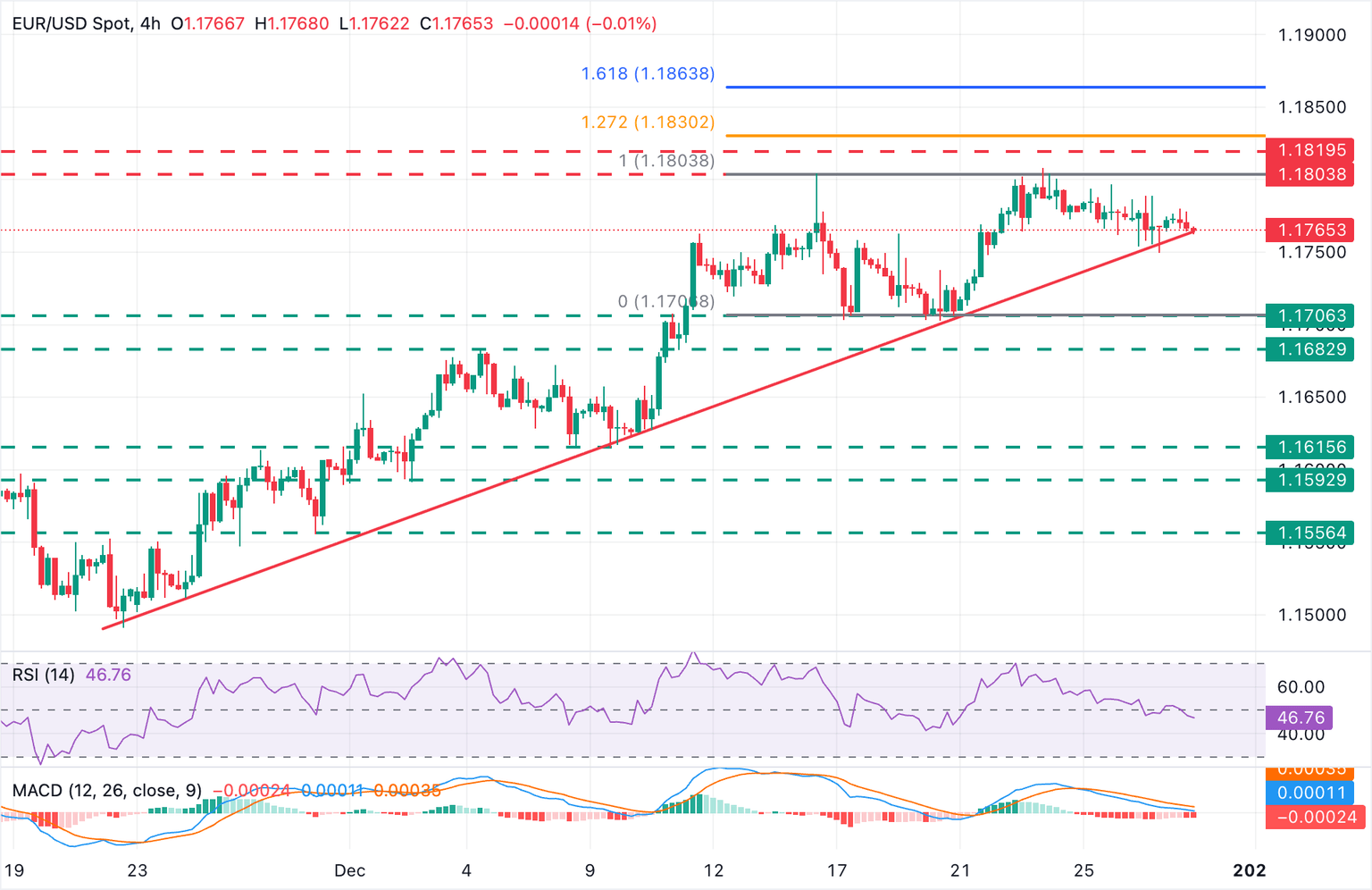
The EUR/USD reversal from last week’s high of 1.1808 has found support at rising trend line support from the mid-November lows, which now stands at 1.1760. However, upside attempts remain limited, as technical indicators show moderate downward momentum. The Relative Strength Index (RSI) on the 4-hour frame is hovering around neutral levels, and the Moving Average Convergence-Divergence (MACD) remains below zero, although a flat curve appears.
Bears face support at the confluence of the mentioned trend line around 1.1760 and Tuesday’s low at 1.1750. Confirmation below this level is needed to challenge the broader uptrend and highlight the lows of December 17-19, near 1.1700.
On the upside, immediate resistance is at the 1.1805 area, where the pair was priced on December 16-24. This level is likely to challenge bulls ahead of the September 23-24 highs near 1.1820. Furthermore, the 161.8% Fibonacci extension of the December 19-24 high at 1.1863 appears as a reasonable target.
Federal Reserve Bank Questions and Answers
Monetary policy in the United States is shaped by the Federal Reserve Bank (Fed). The Federal Reserve has two missions: achieving price stability and promoting full employment. The primary tool for achieving these goals is adjusting interest rates. When prices rise too quickly and inflation is above the Fed’s 2% target, it raises interest rates, which increases borrowing costs throughout the economy. This causes the US dollar (USD) to strengthen because it makes the United States a more attractive place for international investors to park their money. When inflation falls below 2% or when the unemployment rate is very high, the Fed may lower interest rates to encourage borrowing, which affects the dollar.
The Federal Reserve (Fed) holds eight policy meetings annually, where the Federal Open Market Committee (FOMC) assesses economic conditions and makes monetary policy decisions. The FOMC meeting is attended by twelve Fed officials – the seven members of the Board of Governors, the New York Fed president, and four of the remaining eleven regional Fed presidents, who serve one-year terms on a rotating basis.
In extreme cases, the Fed may resort to a policy called quantitative easing (QE). Quantitative easing is the process by which the Federal Reserve dramatically increases the flow of credit into a stuck financial system. It is a non-standard policy measure used during crises or when inflation is very low. It was the Fed’s weapon of choice during the Great Financial Crisis of 2008. It involves the Fed printing more dollars and using them to buy high-quality bonds from financial institutions. Quantitative easing usually weakens the US dollar.
Quantitative tightening (QT) is the reverse process of quantitative easing, where the Fed stops purchasing bonds from financial institutions and does not reinvest capital from bonds it holds outstanding, to purchase new bonds. This is usually positive for the value of the US dollar.