
The AUD/USD pair hit a new yearly high at 0.6740 during the European trading session on Tuesday. The Australian pair is trading strongly with speculators outperforming amid risk-on market sentiment. The attractiveness of risk assets increases as investors digest US military action in Venezuela, which boosted safe-haven demand on Monday.
Australian dollar price today
The table below shows the percentage change in the Australian Dollar (AUD) against the major currencies listed today. The Australian dollar was the strongest against the Swiss franc.
| US dollars | euro | GBP | JPY | Canadian | Australian dollar | New Zealand dollar | Swiss franc | |
|---|---|---|---|---|---|---|---|---|
| US dollars | 0.02% | -0.05% | -0.03% | 0.03% | -0.07% | -0.07% | 0.09% | |
| euro | -0.02% | -0.07% | -0.07% | 0.01% | -0.09% | -0.10% | 0.07% | |
| GBP | 0.05% | 0.07% | 0.00% | 0.08% | -0.02% | -0.03% | 0.14% | |
| JPY | 0.03% | 0.07% | 0.00% | 0.07% | -0.03% | -0.04% | 0.13% | |
| Canadian | -0.03% | -0.01% | -0.08% | -0.07% | -0.10% | -0.11% | 0.05% | |
| Australian dollar | 0.07% | 0.09% | 0.02% | 0.03% | 0.10% | -0.00% | 0.15% | |
| New Zealand dollar | 0.07% | 0.10% | 0.03% | 0.04% | 0.11% | 0.00% | 0.16% | |
| Swiss franc | -0.09% | -0.07% | -0.14% | -0.13% | -0.05% | -0.15% | -0.16% |
The heat map shows the percentage changes in major currencies versus each other. The base currency is chosen from the left column, while the counter currency is chosen from the top row. For example, if you select the Australian dollar from the left column and move along the horizontal line to the US dollar, the percentage change displayed in the box will represent AUD (base)/USD (quote).
Improving market sentiment also weighed on the US Dollar (USD), contributing to the strength of the Australian pair. As of writing, the US Dollar Index (DXY), which tracks the value of the dollar against six major currencies, is trading slightly lower near 98.30.
Going forward, the Australian dollar will be affected by the Consumer Price Index (CPI) data for November, which will be released on Wednesday. Inflation in Australia is expected to grow at an annual pace of 3.7%, slower than 3.8% in October. Investors will be paying close attention to Australian CPI data as the Reserve Bank of Australia (RBA) indicated at its latest policy meeting that monetary conditions could tighten if inflation proves persistent.
Meanwhile, the US dollar will be affected by US non-farm payrolls data for December, which is scheduled to be released on Friday. US NFP data will influence market expectations regarding the Federal Reserve’s monetary policy outlook.
Technical analysis of the AUD/USD pair
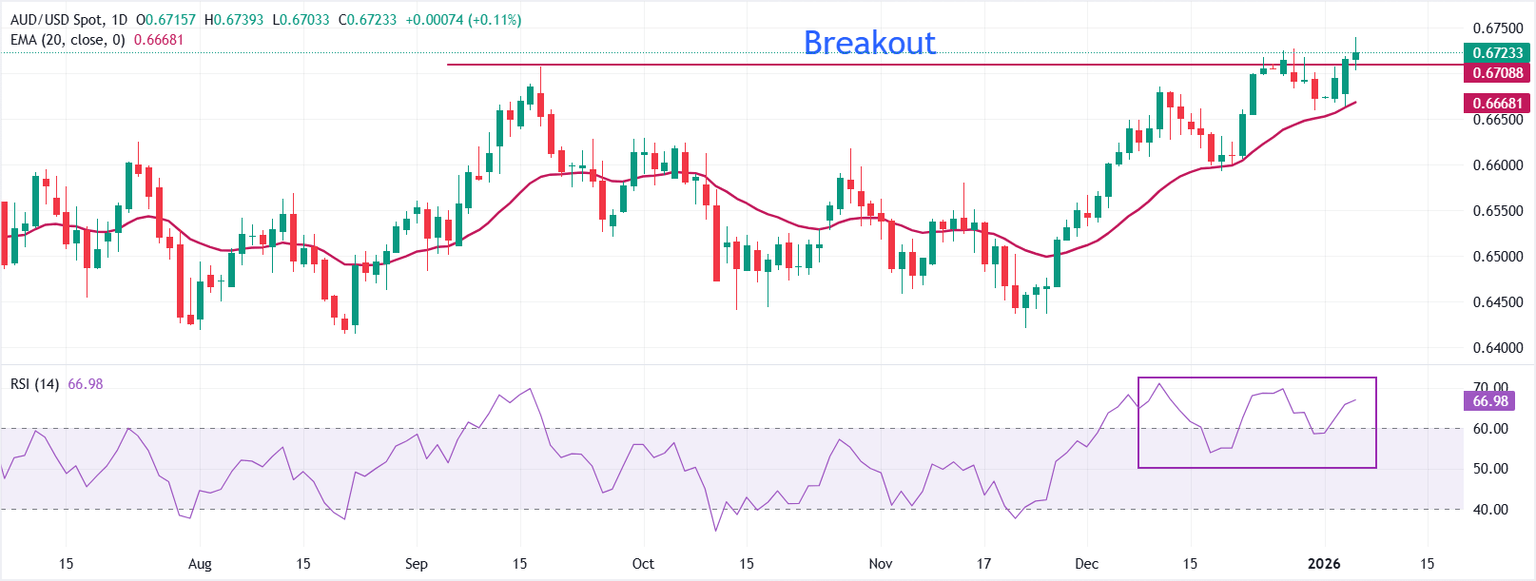
The AUD/USD pair is trading slightly higher near 0.6723 at the time of writing. The pair stands above the 20-day Exponential Moving Average (EMA), which continues to rise and supports a bullish bias. Continuing on this scale keeps the bullish tone intact.
The 14-day RSI at 66.93 is in bullish territory and confirms improving momentum.
The rising 20-day EMA should serve as a dynamic floor for pullbacks, while a daily close below it would weaken the outlook and trigger a deeper bounce towards the full support level at 0.6600. Conversely, sustained trading above the 20-day EMA would keep the way open for additional gains towards the October 2024 high of 0.6935.
(The technical analysis for this story was written with the help of an artificial intelligence tool.)
Frequently asked questions about the US dollar
The US dollar (USD) is the official currency of the United States of America, and the “de facto” currency of a large number of other countries where it is traded alongside local banknotes. It is the world’s most traded currency, accounting for more than 88% of total global forex trading volume, or an average of $6.6 trillion in transactions per day, according to 2022 data. After World War II, the US dollar took the place of the British pound as the world’s reserve currency. For most of its history, the US dollar was backed by gold, until the Bretton Woods Agreement in 1971 when the gold standard disappeared.
The most important factor affecting the value of the US dollar is monetary policy, which is shaped by the Federal Reserve. The Fed has two missions: achieving price stability (controlling inflation) and promoting full employment. The basic tool for achieving these two goals is adjusting interest rates. When prices rise too quickly and inflation is above the Fed’s 2% target, the Fed will raise interest rates, which helps the value of the US dollar. When the inflation rate falls below 2% or when the unemployment rate is very high, the Fed may cut interest rates, which affects the dollar.
In extreme cases, the Fed could also print more dollars and activate quantitative easing (QE). Quantitative easing is the process by which the Federal Reserve dramatically increases the flow of credit into a stuck financial system. It is a non-standard policy measure used when credit dries up because banks will not lend to each other (due to fear of the counterparty defaulting). It is a last resort when simply lowering interest rates is unlikely to achieve the necessary result. It has been the Fed’s weapon of choice to combat the credit crunch that occurred during the Great Financial Crisis of 2008. This involves the Fed printing more dollars and using them to buy U.S. government bonds mostly from financial institutions. Quantitative easing usually leads to a weakening of the US dollar.
Quantitative tightening (QT) is the reverse process whereby the Fed stops purchasing bonds from financial institutions and does not reinvest capital from bonds it holds outstanding in new purchases. It is usually positive for the US dollar.