
The Australian dollar (AUD) rose against the US dollar (USD) on Tuesday after two days of gains. Traders await the release of the Australian November Consumer Price Index (CPI) scheduled for Wednesday.
The Australian dollar could find support after a recent poll of leading economists cited by the Australian Financial Review (AFR), which suggests the Reserve Bank of Australia (RBA) may not be done tightening this cycle. The poll indicates that inflation is expected to remain stubbornly high over the next year, increasing expectations of raising interest rates at least two additional times.
AUD/USD is rising as the US dollar loses strength, as concerns about broader geopolitical escalation ease. Markets have largely ignored tensions between the US and Venezuela.
The US dollar declines as geopolitical escalation subsides
- The US Dollar Index (DXY), which measures the value of the US dollar against six major currencies, continues its losses and is trading around the 98.30 level at the time of writing.
- Traders are awaiting a series of key US economic releases this week, including the Non-Farm Payrolls (NFP) report, for signals on the outlook for monetary policy. The consensus forecast is for nonfarm payrolls to rise by 55,000.
- The United States launched a large-scale military strike against Venezuela on Saturday. US President Donald Trump said that Venezuelan President Nicolas Maduro and his wife were arrested and flown out of the country.
- Venezuelan President Maduro on Monday pleaded not guilty to charges brought against him by the United States in a terrorism and drug case, setting the stage for an unprecedented legal battle with major geopolitical implications, according to Bloomberg.
- President Trump made comments about Colombian leadership, floated the idea of “Operation Colombia,” criticized Mexico for not organizing its work, and suggested that Cuba appeared to be on the verge of collapse, The Guardian reported Monday.
- The US ISM Manufacturing Purchasing Managers’ Index (PMI) fell for the third straight month, falling to 47.9 in December 2025, the lowest since October 2024, from 48.2 in November and below expectations of 48.3. The data indicates a faster contraction in manufacturing activity in the United States, driven by lower production and inventories.
- Traders expect two additional Fed rate cuts in 2026. Markets are preparing for US President Donald Trump to nominate a new Fed head to replace Jerome Powell when his term ends in May, a move that could push monetary policy towards lower interest rates.
- Minutes from the December Federal Open Market Committee (FOMC) meeting last week indicated that most participants viewed it as likely appropriate to stand for further interest rate cuts if inflation declines over time. Meanwhile, some Fed officials said it may be better to leave interest rates unchanged for a while after the committee made three rate cuts last year to support the weak labor market.
- China’s services Purchasing Managers’ Index (PMI), released on Monday, fell to 52.0 in December from 52.1 in November. RatingDog reported last week that the manufacturing PMI rose to 50.1 in December from 49.9 in November. It is important to note that any change in the Chinese economy may affect the Australian dollar, as China and Australia are close trading partners.
- Minutes from the Reserve Bank of Australia’s December meeting indicated that policymakers are prepared to tighten policy if inflation fails to ease as expected, with increasing focus on the fourth-quarter CPI report due on January 28. Analysts note that a stronger-than-expected Q4 core inflation reading could lead to a rate hike at the Reserve Bank of Australia’s February 3 meeting.
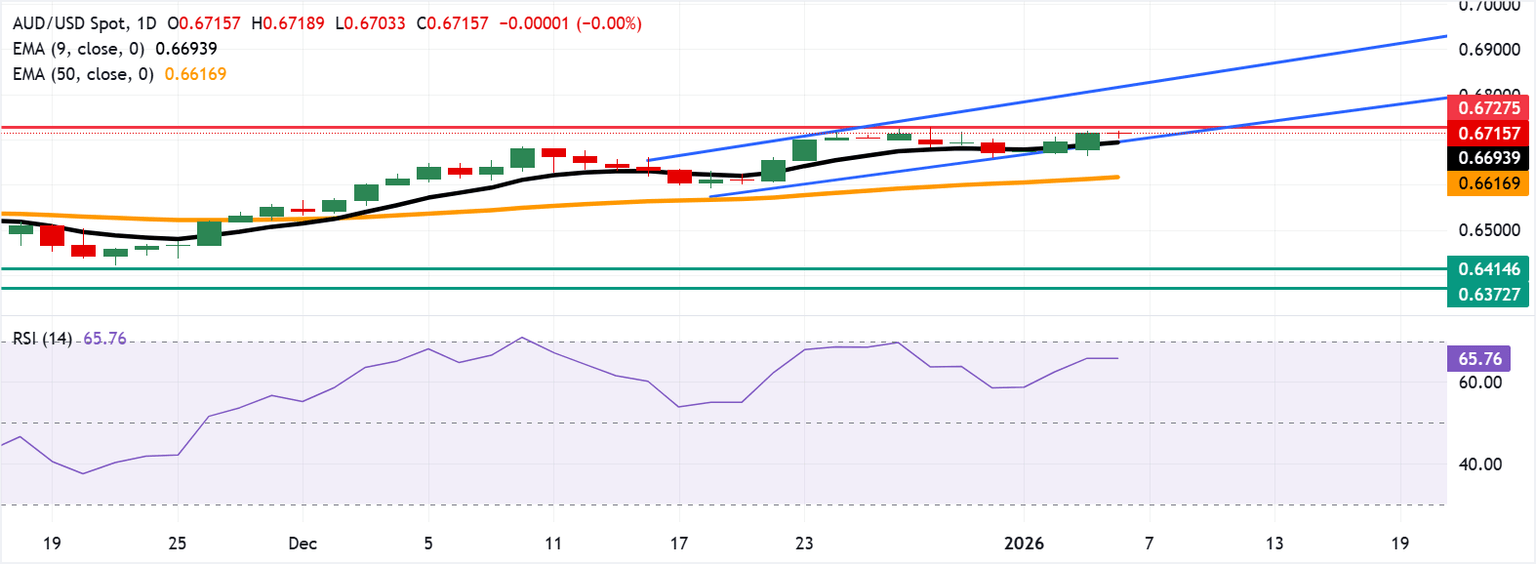
The Australian dollar is eyeing 15-month highs after breaking above the 0.6700 level
The AUD/USD pair is trading around 0.6720 on Tuesday. Technical analysis on the daily chart indicates that the pair is bouncing from the lower border of the ascending channel pattern, indicating a strong upward bias. The 14-day Relative Strength Index (RSI) at 65.64 indicates bullish momentum, with room for further upside towards overbought conditions.
AUD/USD could test the spot barrier at 0.6727, the highest level since October 2024, which was reached on December 29. Further gains may allow the pair to approach the upper border of the ascending channel near 0.6820.
On the downside, the AUD/USD pair may find initial support at the nine-day exponential moving average (EMA) at 0.6693, which is in line with the lower limit of the ascending channel. A break below the channel could expose the AUD/USD pair to the area around the six-month low near 0.6414 hit on August 21.
Australian dollar price today
The table below shows the percentage change in the Australian Dollar (AUD) against the major currencies listed today. The Australian dollar was the strongest against the Japanese yen.
| US dollars | euro | GBP | JPY | Canadian | Australian dollar | New Zealand dollar | Swiss franc | |
|---|---|---|---|---|---|---|---|---|
| US dollars | -0.09% | -0.10% | 0.03% | -0.04% | -0.30% | -0.30% | -0.02% | |
| euro | 0.09% | -0.01% | 0.11% | 0.06% | -0.21% | -0.20% | 0.07% | |
| GBP | 0.10% | 0.00% | 0.13% | 0.07% | -0.20% | -0.19% | 0.08% | |
| JPY | -0.03% | -0.11% | -0.13% | -0.05% | -0.32% | -0.32% | -0.03% | |
| Canadian | 0.04% | -0.06% | -0.07% | 0.05% | -0.27% | -0.27% | 0.01% | |
| Australian dollar | 0.30% | 0.21% | 0.20% | 0.32% | 0.27% | 0.00% | 0.28% | |
| New Zealand dollar | 0.30% | 0.20% | 0.19% | 0.32% | 0.27% | -0.01% | 0.27% | |
| Swiss franc | 0.02% | -0.07% | -0.08% | 0.03% | -0.01% | -0.28% | -0.27% |
The heat map shows the percentage changes in major currencies versus each other. The base currency is chosen from the left column, while the counter currency is chosen from the top row. For example, if you select the Australian dollar from the left column and move along the horizontal line to the US dollar, the percentage change displayed in the box will represent AUD (base)/USD (quote).
Frequently asked questions about the Australian dollar
One of the most important factors for the Australian Dollar (AUD) is the level of interest rates set by the Reserve Bank of Australia (RBA). Because Australia is a resource-rich country, another major driver is the price of its largest export, iron ore. The health of the Chinese economy, its largest trading partner, is one factor, in addition to Australia’s inflation, its growth rate and its trade balance. Market sentiment – whether investors are snapping up riskier assets (risk on) or looking for safe havens (risk off) – is also a factor, with risk appetite positive for the Australian dollar.
The Reserve Bank of Australia (RBA) influences the Australian dollar (AUD) by setting the level of interest rates that Australian banks can lend to each other. This affects the level of interest rates in the economy as a whole. The RBA’s main objective is to maintain a stable inflation rate of 2-3% by adjusting interest rates up or down. Relatively high interest rates compared to other major central banks support the Australian dollar, and relatively low interest rates. The RBA can also use quantitative easing and tightening to influence credit conditions, with the former being AUD negative and the latter AUD positive.
China is Australia’s largest trading partner, so the health of the Chinese economy has a major impact on the value of the Australian Dollar (AUD). When the Chinese economy is performing well, it buys more raw materials, goods and services from Australia, which raises demand for the Australian dollar, raising its value. The opposite is the case when the Chinese economy does not grow as quickly as expected. Therefore, positive or negative surprises in Chinese growth data often have a direct impact on the Australian dollar and its crosses.
Iron ore is Australia’s largest export, representing $118 billion annually according to 2021 data, and China is its main destination. Therefore, the price of iron ore could be a driver of the Australian dollar. In general, if the price of iron ore rises, the Australian dollar also rises, as overall demand for the currency increases. The opposite is the case if the price of iron ore falls. Higher iron ore prices also tend to increase the likelihood of a positive trade balance for Australia, which is also positive for the Australian dollar.
The balance of trade, which is the difference between what a country earns from its exports versus what it pays for its imports, is another factor that can affect the value of the Australian dollar. If Australia produces highly sought-after exports, its currency will gain value from the excess demand generated by foreign buyers seeking to buy its exports in exchange for what it spends to buy imports. Therefore, a positive net trade balance strengthens the Australian dollar, with the opposite effect if the trade balance is negative.