General Motors dropped new news Thursday evening that should grab every trader’s attention: a staggering $7.1 billion in fourth-quarter charges, with $6 billion directly tied to its struggling electric vehicle operations. The timing of this announcement couldn’t be worse, technically speaking.
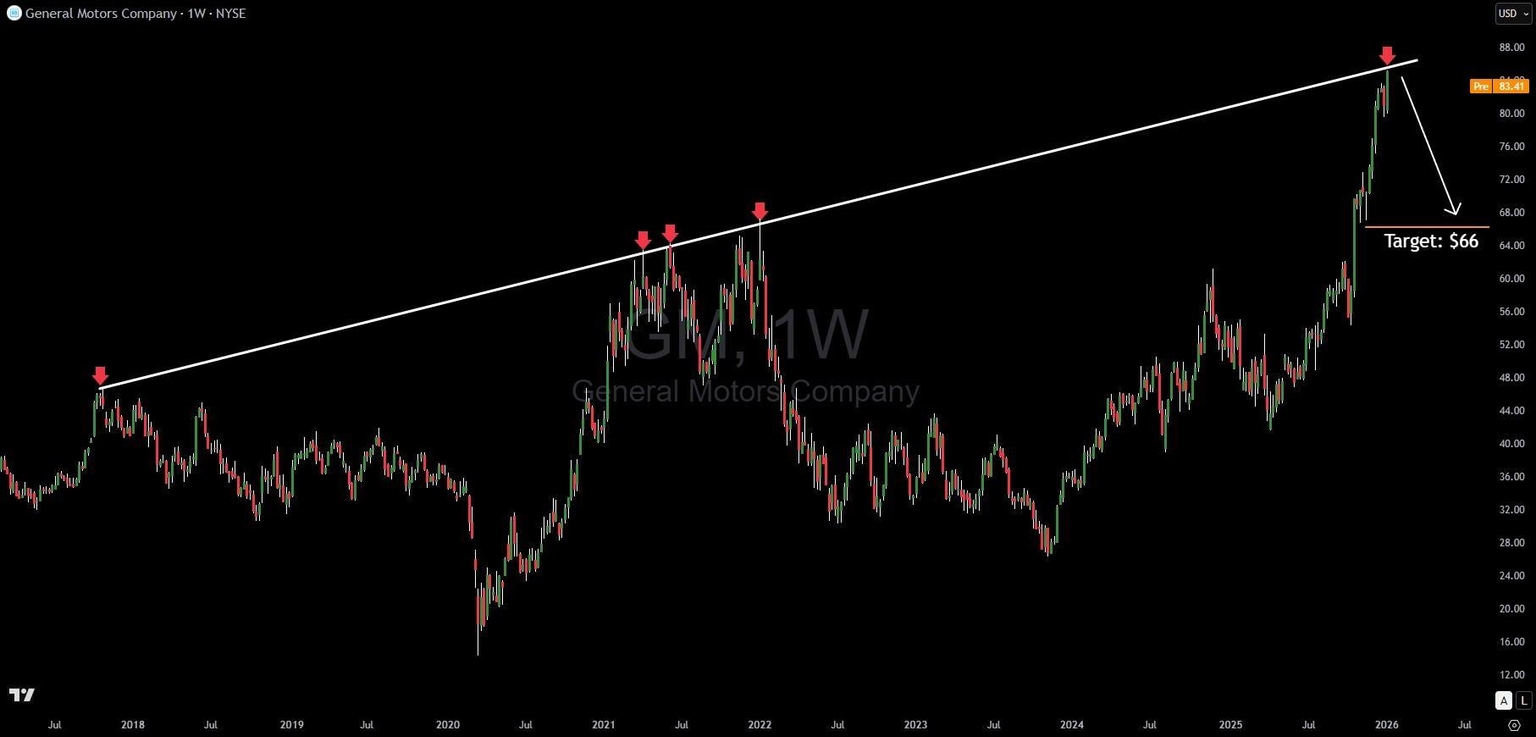
Looking at the weekly chart of General Motors, the stock recently rose to $85, testing a multi-year bullish resistance trend line that has repeatedly rejected price advances since 2017. And each time, sellers have emerged in force.
The recent rejection at $85 looks like a textbook one. The price is currently at $83.36 before entering the market, but the damage from this fundamental bomb could accelerate what technicians were already suggesting: a return towards the $66 level.
The write-down of electric vehicles stems from weak demand after federal tax credits expired in September, forcing GM to cut production capacity and settle expensive contracts with suppliers that had braced for much higher volumes. Even more surprising is the $4.2 billion cash component, which is real money going out the door in supplier settlements and contract cancellations. GM warns that additional fees are coming in 2026, although management expects them to be lower.
From a technical point of view, the bullish resistance trend line has proven reliable for years. When overhead resistance combines with a fundamental headwind of this magnitude, the path of least resistance usually points down. The $66 target represents a logical destination based on previous support levels and chart structure.
For traders watching GM, this setup combines technical rejection with deteriorating fundamentals – a combination that often leads to sustained moves. The question is not whether pressure exists, but how quickly it appears in price action.