
The British pound (GBP) traded lower against major currencies, falling 0.2% to 1.3420 against the US dollar (US) on Thursday, following the release of monthly UK GDP data for November.
The Office for National Statistics (ONS) reports that the economy is back in the black with a bang. The data showed that GDP growth reached 0.3%, faster than estimates of 0.1%. In September and October, the British economy fell by 0.1% after remaining flat in August.
The UK’s strong GDP figure is expected to negatively impact the Bank of England’s (BoE) dovish outlook. At its December meeting, the Bank of England indicated that monetary policy would remain on a gradual downward path.
On Wednesday, the Bank of England’s policy member, Alan Taylor, said he expects “monetary policy to normalize to neutral sooner rather than later”, and “targeted inflation from mid-2026 is likely to be sustainable”.
Meanwhile, UK factory data came in stronger than expected. On a monthly basis, industrial production grew at a solid pace of 2.1% versus estimates of 0.5% and October’s reading of 0.4%, revised down from 0.5%. In the same period, industrial production rose by 1.1%, stronger than the 0.1% forecast, but slower than the previous reading of 1.3%. On a yearly basis, both manufacturing and industrial production rose unexpectedly at a strong pace.
The price of the British pound today
The table below shows the percentage change of the British Pound (GBP) against the major currencies listed today. The British pound was the weakest against the Australian dollar.
| US dollars | euro | GBP | JPY | Canadian | Australian dollar | New Zealand dollar | Swiss franc | |
|---|---|---|---|---|---|---|---|---|
| US dollars | 0.06% | 0.08% | -0.11% | 0.12% | -0.22% | -0.06% | -0.02% | |
| euro | -0.06% | 0.03% | -0.17% | 0.06% | -0.28% | -0.12% | -0.07% | |
| GBP | -0.08% | -0.03% | -0.17% | 0.04% | -0.30% | -0.15% | -0.10% | |
| JPY | 0.11% | 0.17% | 0.17% | 0.21% | -0.12% | 0.00% | 0.08% | |
| Canadian | -0.12% | -0.06% | -0.04% | -0.21% | -0.33% | -0.19% | -0.13% | |
| Australian dollar | 0.22% | 0.28% | 0.30% | 0.12% | 0.33% | 0.15% | 0.20% | |
| New Zealand dollar | 0.06% | 0.12% | 0.15% | -0.00% | 0.19% | -0.15% | 0.05% | |
| Swiss franc | 0.02% | 0.07% | 0.10% | -0.08% | 0.13% | -0.20% | -0.05% |
The heat map shows the percentage changes in major currencies versus each other. The base currency is chosen from the left column, while the counter currency is chosen from the top row. For example, if you select the British pound from the left column and move along the horizontal line to the US dollar, the percentage change displayed in the box will represent GBP (base)/USD (quote).
Daily summary Market drivers: The British pound traded lower against the US dollar
- Earlier in the day, the British pound came under pressure as market sentiment remained risk-off due to renewed tariff tensions. US President Donald Trump on Wednesday imposed a 25% tariff on imports of some advanced computing chips by the White House, which include Nvidia’s H200 AI processor and a similar semiconductor from AMD called the MI325X.
- However, the British pound is trading lower against the US dollar around 1.3425 during the European trading session on Thursday, as the US dollar strengthened amid expectations that the Federal Reserve Bank (Fed) will keep interest rates steady at the next meeting.
- At press time, the US Dollar Index (DXY), which tracks the value of the US currency against six major currencies, was up 0.15% to approach a monthly high of 99.26.
- According to the CME FedWatch tool, the Fed is certain to leave interest rates unchanged in the 3.50%-3.75% range at its January policy meeting, signaling a pause in its monetary easing drive. In the last three meetings, the Fed has made three consecutive 25 basis point rate cuts amid weak labor market conditions.
- Speculation that the Fed will leave interest rates steady is fueled by expectations that the impact of the latest cuts has yet to be felt on the economy. US CPI data for December also showed that price pressures grew steadily.
- On Wednesday, Atlanta Fed President Rafael Bostic stressed the need to maintain a restrictive monetary policy stance in the near term, noting that “the inflation challenge has not yet been overcome.”
Technical Analysis: GBP/USD maintains 50% Fibonacci retracement levels at 1.3400
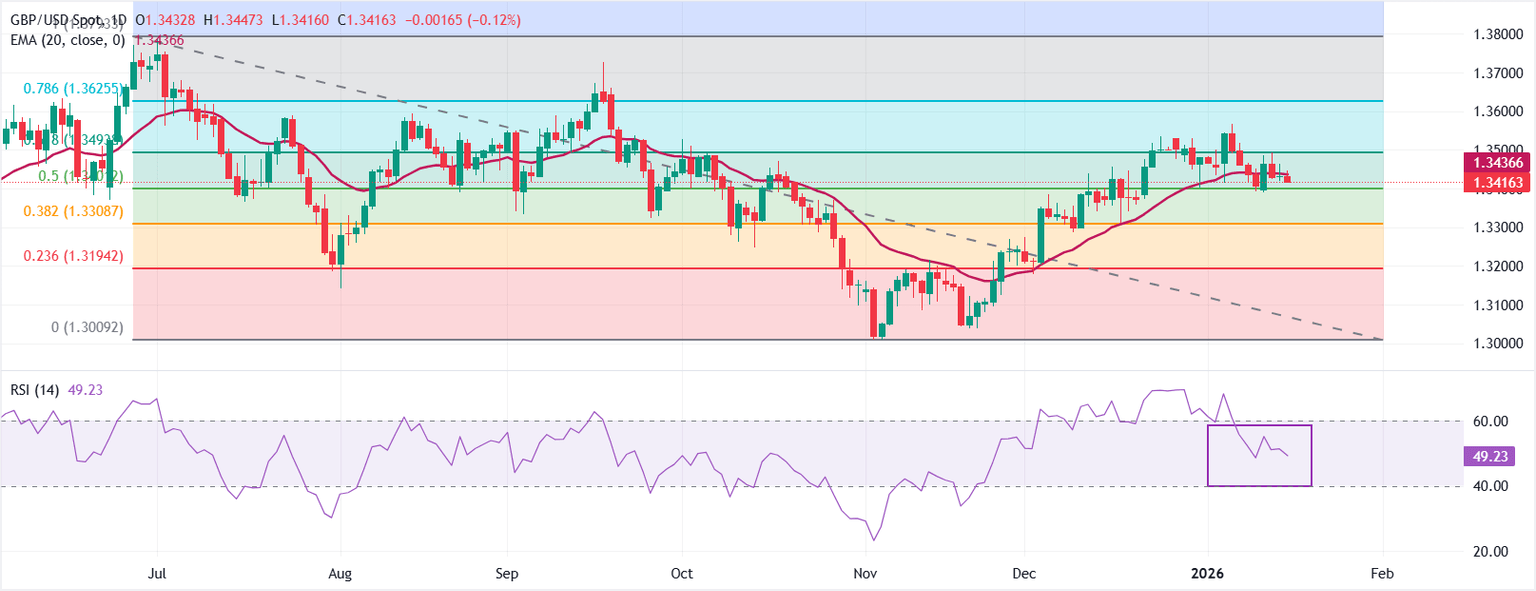
GBP/USD is trading lower near 1.3420 at the time of writing. The 20-day exponential moving average (EMA) settled at 1.3438 after a steady rise, with the price bouncing around it.
The 14-day RSI at 49.23 is neutral, indicating balanced momentum.
Measured from the high of 1.3793 to the low of 1.3009, the 61.8% Fibonacci retracement levels at 1.3494 cap the retracement, while the 78.6% Fibonacci retracement levels at 1.3625 loom. A break to the upside could extend the recovery towards the September 2025 high of 1.3726, while a rejection would keep trading range-bound around the 20-day EMA.
(The technical analysis for this story was written with the help of an artificial intelligence tool.)
Frequently asked questions about GDP
A country’s GDP measures the growth rate of its economy over a certain period of time, usually a quarter. The most reliable numbers are those that compare GDP with the previous quarter, for example the second quarter of 2023 versus the first quarter of 2023, or with the same period the previous year, for example, the second quarter of 2023 versus the second quarter of 2022. Annual quarterly GDP numbers extrapolate the quarter’s growth rate as if it were constant for the rest of the year. This can be misleading, however, if temporary shocks affect growth in one quarter but are unlikely to persist throughout the year – as happened in the first quarter of 2020 when the Covid pandemic struck, when growth declined.
A high GDP result is generally considered positive for a country’s currency because it reflects a growing economy, which is more likely to produce goods and services that can be exported, as well as attract higher foreign investment. In the same vein, when GDP falls, it is usually negative for the currency. When the economy grows, people tend to spend more, which leads to inflation. The country’s central bank must then raise interest rates to combat inflation with the side effect of attracting more capital inflows from global investors, thus helping the local currency rise.
When the economy grows and GDP rises, people tend to spend more which leads to inflation. The country’s central bank must then raise interest rates to combat inflation. High interest rates are negative for gold because they increase the opportunity cost of holding gold versus putting money in a cash deposit account. Therefore, a higher GDP growth rate is usually a bearish factor for the gold price.