
The EUR/USD pair continues its losses for the fifth day in a row and is trading at 1.1515 at the time of writing on Thursday after a sharp reversal from levels near 1.1600 on Wednesday. The US Dollar’s (USD) positive reaction to the hawkish minutes of the Federal Reserve (Fed) meeting and traders’ caution ahead of the much-awaited US Non-Farm Payrolls (NFP) report for September, has strengthened the US Dollar across the board.
Minutes from the October Federal Open Market Committee (FOMC) meeting revealed on Wednesday that many Fed officials were against cutting interest rates, fearing it could hurt the fight against inflation and deteriorate public confidence in the central bank. These comments have cast further doubt on the possibility of successive interest rate cuts in December.
The chances of a quarter-point rate cut at the Dec. 10 meeting fall to less than 30%, according to CME Group’s FedWatch tool, from 50% on Wednesday, and more than 90% one month ago. The US dollar rose in the meantime.
In the euro zone, construction output data showed that the sector’s decline accelerated in September. Later in the day, the preliminary November consumer confidence reading released by the European Commission may give some additional guidance to the euro. In the US, the focus will be on the September non-farm payrolls report and the Philadelphia Fed’s manufacturing survey.
Euro price today
The table below shows the percentage change of the Euro (EUR) against the major currencies listed today. The euro was the strongest against the Japanese yen.
| US dollars | euro | GBP | JPY | Canadian | Australian dollar | New Zealand dollar | Swiss franc | |
|---|---|---|---|---|---|---|---|---|
| US dollars | 0.12% | -0.08% | 0.46% | 0.06% | -0.12% | -0.27% | 0.19% | |
| euro | -0.12% | -0.19% | 0.33% | -0.05% | -0.23% | -0.38% | 0.08% | |
| GBP | 0.08% | 0.19% | 0.51% | 0.14% | -0.04% | -0.19% | 0.27% | |
| JPY | -0.46% | -0.33% | -0.51% | -0.39% | -0.55% | -0.74% | -0.26% | |
| Canadian | -0.06% | 0.05% | -0.14% | 0.39% | -0.17% | -0.34% | 0.11% | |
| Australian dollar | 0.12% | 0.23% | 0.04% | 0.55% | 0.17% | -0.15% | 0.31% | |
| New Zealand dollar | 0.27% | 0.38% | 0.19% | 0.74% | 0.34% | 0.15% | 0.46% | |
| Swiss franc | -0.19% | -0.08% | -0.27% | 0.26% | -0.11% | -0.31% | -0.46% |
The heat map shows the percentage changes in major currencies versus each other. The base currency is chosen from the left column, while the counter currency is chosen from the top row. For example, if you select EUR from the left column and move along the horizontal line to USD, the percentage change displayed in the box will represent EUR (base)/USD (quote).
Daily summary of market drivers: Dollar rises as Fed easing hopes decline
- Minutes from the Fed’s latest meeting reflect the committee’s split in October, with some policymakers showing a preference for leaving interest rates unchanged while others refused to cut rates outright. This, coupled with the lack of official data following the 43-day government shutdown, has prompted investors to scale back their hopes for an interest rate cut by the central bank in December, which is supporting the US dollar.
- In Japan, Finance Minister Satsuki Katayama confirmed that she did not talk about foreign currencies in the meeting with Bank of Japan Governor Kazuo Ueda, which markets interpreted as a signal that the authorities are not planning to intervene yet, and lifted the US dollar to its highest levels almost since the beginning of the year against the Japanese yen.
- The euro failed to get any significant support from improving market sentiment after chipmaker Nvidia reported better-than-expected quarterly earnings, allaying concerns about overvaluation of artificial intelligence-related companies and sparking a comfortable rally in Asia.
- Later Thursday, the delayed US nonfarm payrolls report for September is expected to show a net increase of 50,000 new jobs, after a rise of 22,000 in August. Average hourly earnings are expected to grow at a monthly rate of 0.3% and 3.7% compared to September of last year, in both cases at the same pace as in August. The unemployment rate is expected to remain steady at 4.3%.
- At the same time, the Philadelphia Fed’s manufacturing survey is expected to show that business conditions deteriorated for the second straight month in November, although to a lesser extent than in October. The index is expected to record -3.1 after reading -12.8 in the previous month.
- Eurozone data released earlier today revealed that construction output in the region contracted by 0.5% in September, after a downwardly revised decline of 0.2% in August. On an annual basis, the sector’s output fell by 0.3%, partly reflecting growth of 1% in the previous month
- Later Thursday, the Conference Board’s preliminary consumer confidence index is expected to improve for the fourth month in a row, to -14.0 in November, from -14.2 in October.
Technical analysis: EUR/USD remains on the defensive, with 1.1500 in sight
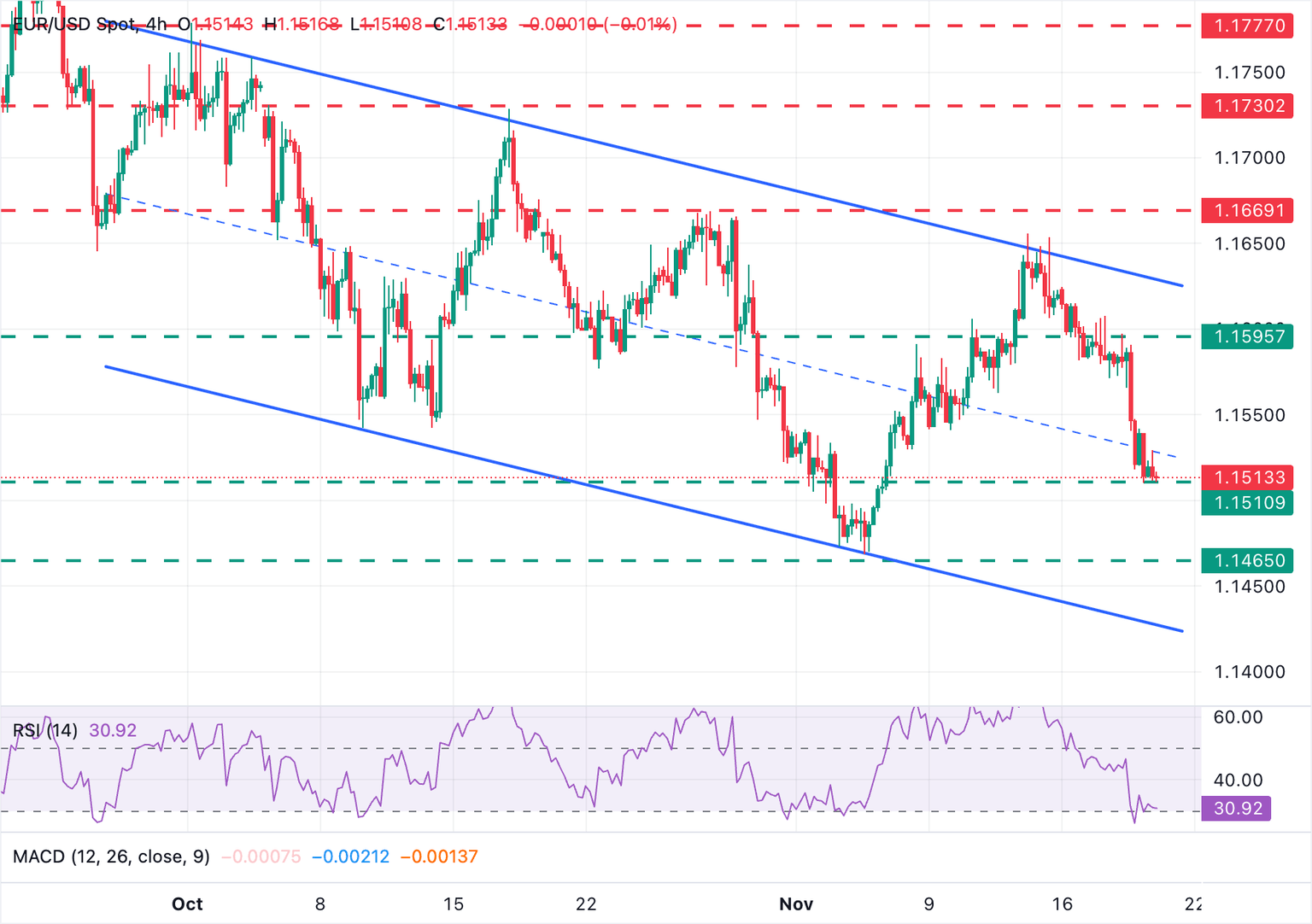
EUR/USD is on a short-term downtrend after being rejected near 1.1650 last week, with bears testing the 1.1500 support area. The Relative Strength Index (RSI) Momentum indicator on the 4-hour frame has reached oversold levels, indicating the possibility of some consolidation. A major recovery seems unlikely unless the underlying context changes radically.
At the time of writing, EUR/USD has found some support just above the 1.1500 psychological level. In the event of a further decline, the pair may look for support at the lows recorded on November 5 near 1.1470, ahead of the bottom of the downward channel on the upcoming 4-hour chart from late September, which now lies near 1.1430.
On the upside, the November 18-19 highs at 1.1600 are likely to challenge bulls before the top of the down channel, which is now around 1.1630. An unexpected upward move beyond that area will highlight the October 28-29 highs, near 1.1670.
Economic indicator
Nonfarm payrolls
The Nonfarm Payrolls release shows the number of new jobs created in the United States during the previous month at all nonfarm businesses. Released by US Bureau of Labor Statistics (Plus). Monthly changes in payroll can be very volatile. The number is also subject to strong revisions, which can also create fluctuations in the Forex board. In general, a high reading is considered bullish for the US Dollar (USD), while a low reading is considered bearish, although revisions to the previous months and the unemployment rate are just as important as the headline number. Therefore, the market reaction depends on how the market evaluates all the data in the BLS report as a whole.
Read more.
Next release:
Thursday 20 November 2025 at 1:30
repetition:
monthly
consensus:
50 thousand
former:
22 k
source:
US Bureau of Labor Statistics
The monthly jobs report in America is considered the most important economic indicator for Forex traders. The change in the number of jobs, released on the first Friday of the month, is closely linked to the overall performance of the economy and is monitored by policymakers. Full employment is one of the powers of the Fed and it takes into account developments in the labor market when setting its policies, thus affecting currencies. Although there are several key indicators that make up estimates, the Non-Farm Payrolls report tends to surprise markets and trigger significant volatility. Actual numbers that beat consensus tend to be bullish for the US dollar.
Economic indicator
Unemployment rate
Unemployment rate issued by US Bureau of Labor Statistics (BLS), is the percentage of the total civilian labor force that is not in paid employment but is actively looking for work. The rate is usually higher in recessionary economies than in growing economies. Generally, a decrease in the unemployment rate is viewed as bullish for the US Dollar (USD), while an increase is viewed as bearish. However, the number by itself usually cannot determine the direction of the next market movement, as this will also depend on the headline non-farm payrolls reading, and other data in the BLS report.
Read more.