
The EUR/USD pair is sitting near 1.1710 at the opening times of the US session on Friday, down from three-month highs, above 1.1800, hit earlier this week. The pair is on track to close the week with moderate losses, as the US dollar rose against its major counterparts.
The euro extended losses on Thursday after the European Central Bank left interest rates unchanged, as widely expected, and ECB President Christine Lagarde refused to commit to any particular rate path. Lagarde confirmed that the decision was taken unanimously and there was no discussion of changing interest rates, which indicates that market speculation about raising interest rates is unfounded.
In the US, the November CPI revealed an unexpected decline in inflation, with the annual rate falling to 2.7% from 3.0% in September, as the October reading was canceled due to the US government shutdown. The market has taken these numbers with caution, and rightly so, as the Commerce Department confirmed that it only collected data from the second half of the month, with Black Friday sales already underway.
On Friday in the US, the main focus will be on the US Michigan Consumer Confidence Index and the European Commission’s preliminary Consumer Confidence Survey for December.
Euro price today
The table below shows the percentage change of the Euro (EUR) against the major currencies listed today. The euro was the strongest against the Japanese yen.
| US dollars | euro | GBP | JPY | Canadian | Australian dollar | New Zealand dollar | Swiss franc | |
|---|---|---|---|---|---|---|---|---|
| US dollars | 0.08% | 0.03% | 0.45% | 0.06% | 0.08% | 0.30% | 0.13% | |
| euro | -0.08% | -0.05% | 0.38% | -0.01% | 0.00% | 0.22% | 0.05% | |
| GBP | -0.03% | 0.05% | 0.44% | 0.04% | 0.05% | 0.27% | 0.10% | |
| JPY | -0.45% | -0.38% | -0.44% | -0.39% | -0.39% | -0.18% | -0.34% | |
| Canadian | -0.06% | 0.01% | -0.04% | 0.39% | 0.01% | 0.21% | 0.06% | |
| Australian dollar | -0.08% | -0.01% | -0.05% | 0.39% | -0.01% | 0.21% | 0.04% | |
| New Zealand dollar | -0.30% | -0.22% | -0.27% | 0.18% | -0.21% | -0.21% | -0.17% | |
| Swiss franc | -0.13% | -0.05% | -0.10% | 0.34% | -0.06% | -0.04% | 0.17% |
The heat map shows the percentage changes in major currencies versus each other. The base currency is chosen from the left column, while the counter currency is chosen from the top row. For example, if you select EUR from the left column and move along the horizontal line to USD, the percentage change displayed in the box will represent EUR (base)/USD (quote).
Market drivers in daily summary: Euro declines as ECB continues ‘wait and see’ stance.
- The euro is pulling back from recent highs, as investors come to terms with the fact that it is still too early to bet on a rate hike by the European Central Bank. However, downward attempts are likely to remain limited, as the US Federal Reserve is expected to cut interest rates at least twice in 2026.
- The ECB left the deposit facility interest rate unchanged at 2%, as expected, and revised its economic growth forecast to 1.4% in 2025 and 1.2% in 2026. However, President Lagarde said all options are open and that there is no date for any monetary policy move.
- ECB Governing Council member and Latvian central bank governor Martins Khazakhs reiterated this view on Friday, warning that talking about the direction of interest rates is counterproductive, because the national bank needs “total discretion, with risks on both sides.”
- In the United States, Consumer Price Index figures showed that inflation fell to an annual rate of 2.7% in November, from 3.0% in September, against expectations of a slight increase to 3.1%. Likewise, core inflation fell to an annual rate of 2.6% from 3% in September.
- The German confidence survey released on Friday showed further deterioration, with the January reading falling to -26.9 from -23.4 the previous month, and below market expectations for a reading of -23.2.
- The German producer price index, also released on Friday, revealed that factory inflation stalled in November, down from a 0.1% rise in October, and contracted at a rate of 2.3% in the past 12 months, less than the 1.8% decline seen in October and also less than the 2.2% contraction forecast by market consensus.
- Later in the day, preliminary consumer confidence in the Eurozone is expected to show a slight improvement to -14.0 in December from -14.2 in November.
- Meanwhile, the US Michigan Consumer Confidence Index for December is expected to be revised to 53.4 from a preliminary reading of 53.3.
Technical analysis: The EUR/USD pair is expected to find support at 1.1700
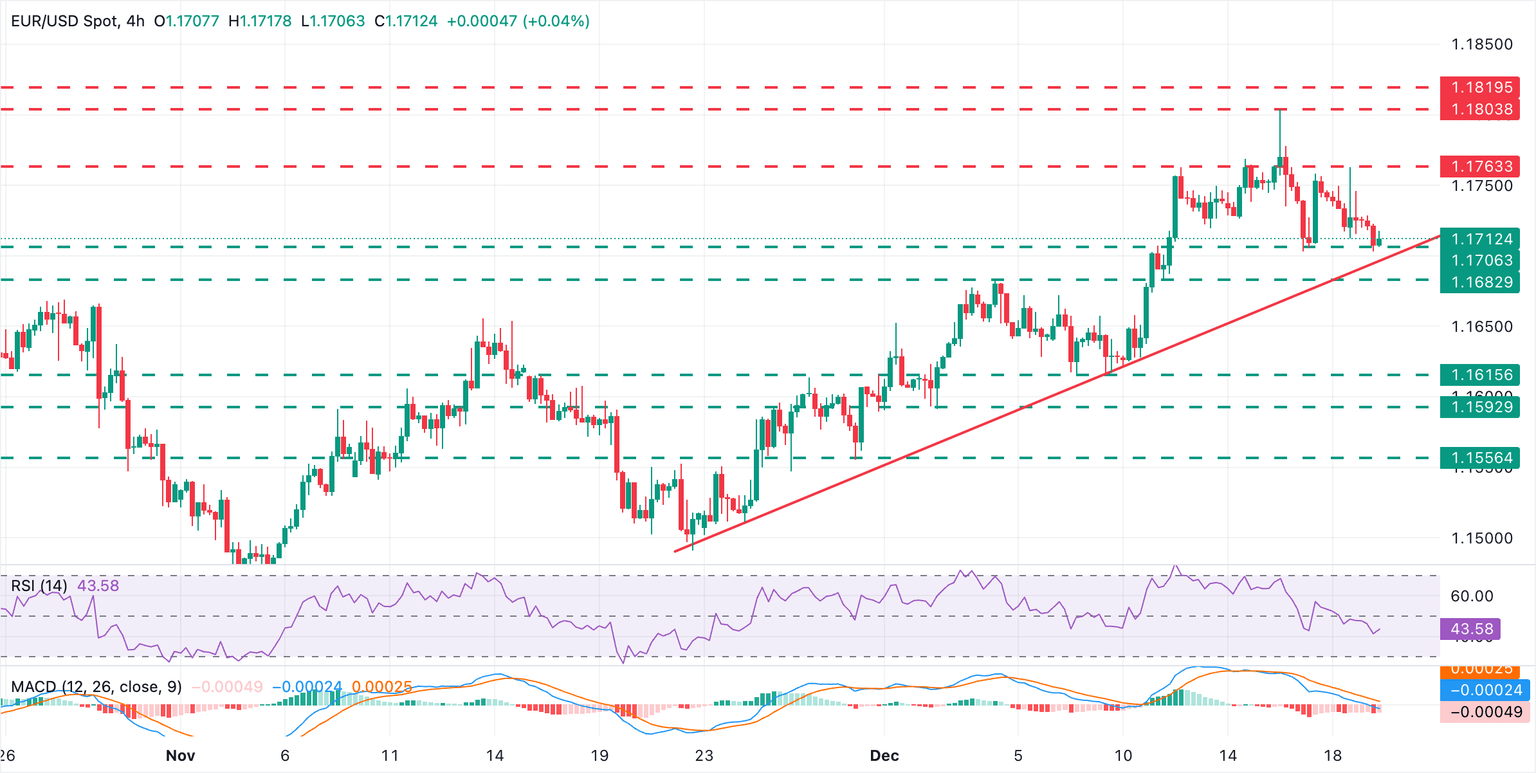
EUR/USD remains under moderate bearish pressure, with bears focusing on the 1.1700 support area. The Relative Strength Index (RSI) on the 4-hour frame is trending lower below the 50 mid-line, and the Moving Average Convergence-Divergence (MACD) remains below zero, printing red bars, indicating increasing negative momentum.
Dec 17 low at 1.1703 and trend line support, now around 1.1695, are likely to challenge bears before 1.1685 (Dec 11 low, Dec 4 high). Confirmation below this level would invalidate the bullish view and highlight the December 9 low at 1.1615.
On the upside, immediate resistance lies at Thursday’s high near 1.1760, ahead of Tuesday’s high at 1.1804, and the September 23-24 high near 1.1820.
Economic indicator
Michigan Consumer Confidence Index
Michigan Consumer Confidence Index, released on a monthly basis by University of Michiganis a survey that measures sentiment among consumers in the United States. The questions cover three broad areas: personal finances, working conditions, and terms of purchase. The data shows a picture of whether or not consumers are willing to spend money, which is a key factor because consumer spending is the main driver of the U.S. economy. The survey conducted by the University of Michigan has proven to be an accurate indicator of the future path of the American economy. The survey is published as a preliminary reading in the middle of the month and a final edition at the end of the month. In general, a high reading is considered bullish for the US Dollar (USD), while a low reading is considered bearish.
Read more.
Next release:
Friday 19 December 2025 at 15:00
repetition:
monthly
consensus:
53.4
former:
53.3
source:
University of Michigan
Consumer exuberance could translate into greater spending and faster economic growth, which would imply a stronger labor market and potentially higher inflation, which would help shift the Fed to a hawkish stance. The popularity of this survey among analysts (cited more frequently than CB’s Consumer Sentiment) is justified because the data here includes interviews conducted up to a day or two before the official release, making it a timely measure of consumer mood, but above all because it measures consumers’ attitudes on finances and income. Actual numbers that beat consensus tend to be bullish for the US dollar.
Economic indicator
Consumer confidence
Consumer confidence issued by European Commission It is a leading indicator that measures the level of consumer confidence in economic activity. A high level of consumer confidence stimulates economic expansion while a low level leads to economic contraction. A high reading is considered positive (or bullish) for the EUR, while a low reading is considered negative (or bearish).
Read more.
Next release:
Friday 19 December 2025 at 15:00 (before)
repetition:
monthly
consensus:
-14
former:
-14.2
source:
European Commission