
The EUR/USD pair gave up previous gains on Tuesday and is trading at 1.1710, after rejection at 1.1740. A downward revision to Eurozone services sector PMI numbers for December renewed downward pressure on the euro. Which bounced higher on Monday amid weak US manufacturing activity data and downbeat comments from Federal Reserve spokesmen.
The eurozone services PMI (HCOB) was revised down to 52.4, from the previous estimate of 52.6, and a reading of 53.1 in November. The market is now awaiting the preliminary reading of the German Harmonized Consumer Price Index (HICP) for December, which may determine the direction of the Euro in the near term.
US ISM Manufacturing PMI figures on Monday revealed that the sector’s business activity fell at its fastest pace in the past 14 months, with new orders contracting while prices continue to rise. This, coupled with some dovish comments by Minneapolis Fed President Neel Kashkari, renewed hopes for further monetary easing by the US central bank, sending the US dollar lower.
In the US session on Tuesday, Richmond Fed President Thomas Barkin’s speech and the final S&P Global Services PMI may have some impact on the US dollar, although the main focus is on a series of US labor data, due later this week, especially Friday’s Non-Farm Payrolls (NFP) report.
Euro price today
The table below shows the percentage change of the Euro (EUR) against the major currencies listed today. The euro was the strongest against the Swiss franc.
| US dollars | euro | GBP | JPY | Canadian | Australian dollar | New Zealand dollar | Swiss franc | |
|---|---|---|---|---|---|---|---|---|
| US dollars | 0.08% | 0.00% | 0.05% | 0.02% | -0.07% | -0.08% | 0.13% | |
| euro | -0.08% | -0.06% | -0.05% | -0.05% | -0.15% | -0.15% | 0.05% | |
| GBP | -0.01% | 0.06% | 0.02% | 0.00% | -0.09% | -0.09% | 0.11% | |
| JPY | -0.05% | 0.05% | -0.02% | -0.02% | -0.11% | -0.13% | 0.08% | |
| Canadian | -0.02% | 0.05% | -0.01% | 0.02% | -0.09% | -0.11% | 0.10% | |
| Australian dollar | 0.07% | 0.15% | 0.09% | 0.11% | 0.09% | -0.01% | 0.19% | |
| New Zealand dollar | 0.08% | 0.15% | 0.09% | 0.13% | 0.11% | 0.00% | 0.20% | |
| Swiss franc | -0.13% | -0.05% | -0.11% | -0.08% | -0.10% | -0.19% | -0.20% |
The heat map shows the percentage changes in major currencies versus each other. The base currency is chosen from the left column, while the counter currency is chosen from the top row. For example, if you select EUR from the left column and move along the horizontal line to USD, the percentage change displayed in the box will represent EUR (base)/USD (quote).
Daily Summary Market Drivers: Markets cautious with key US employment releases ahead
- The EUR/USD is experiencing volatile trading on Tuesday. Recent macroeconomic data from Europe and the US failed to convince traders, and the market is awaiting a series of key US business reports to better assess the timing of the Fed’s easing calendar.
- Data released on Monday revealed that the US ISM Manufacturing PMI fell to 47.9 in December from 48.2 in November, compared with expectations for a slight improvement to 48.3. New orders rose to 47.7 from 47.4 in the previous month but remained in contraction territory, while the prices paid sub-index remained unchanged at 58.5, levels that reflect significant inflationary pressures.
- Later, Minneapolis Fed President Neel Kashkari said inflationary pressures were slowly trending downward, but warned that the unemployment rate could “spike” higher, supporting market hopes for further monetary easing from the Fed.
- Geopolitical concerns stemming from US military intervention in Venezuela have remained mostly subdued. Nicolas Maduro pleaded not guilty in federal court in New York, and investors accepted China’s warnings about “hegemonic acts” that violate international law.
- In the eurozone calendar, the main attraction will be preliminary German CPI numbers for December, which are expected to show that inflation rose by 0.4% in the month, from -0.5% in November. However, the annual rate is expected to fall to 2.2% from 2.6% in the previous month.
- In the US, the final S&P Global Services PMI is the only macroeconomic release worth mentioning today. Preliminary estimates showed a slowdown to 52.9 in December, from 54.1 in November.
Technical analysis: The EUR/USD pair is wavering above the 1.1700 level
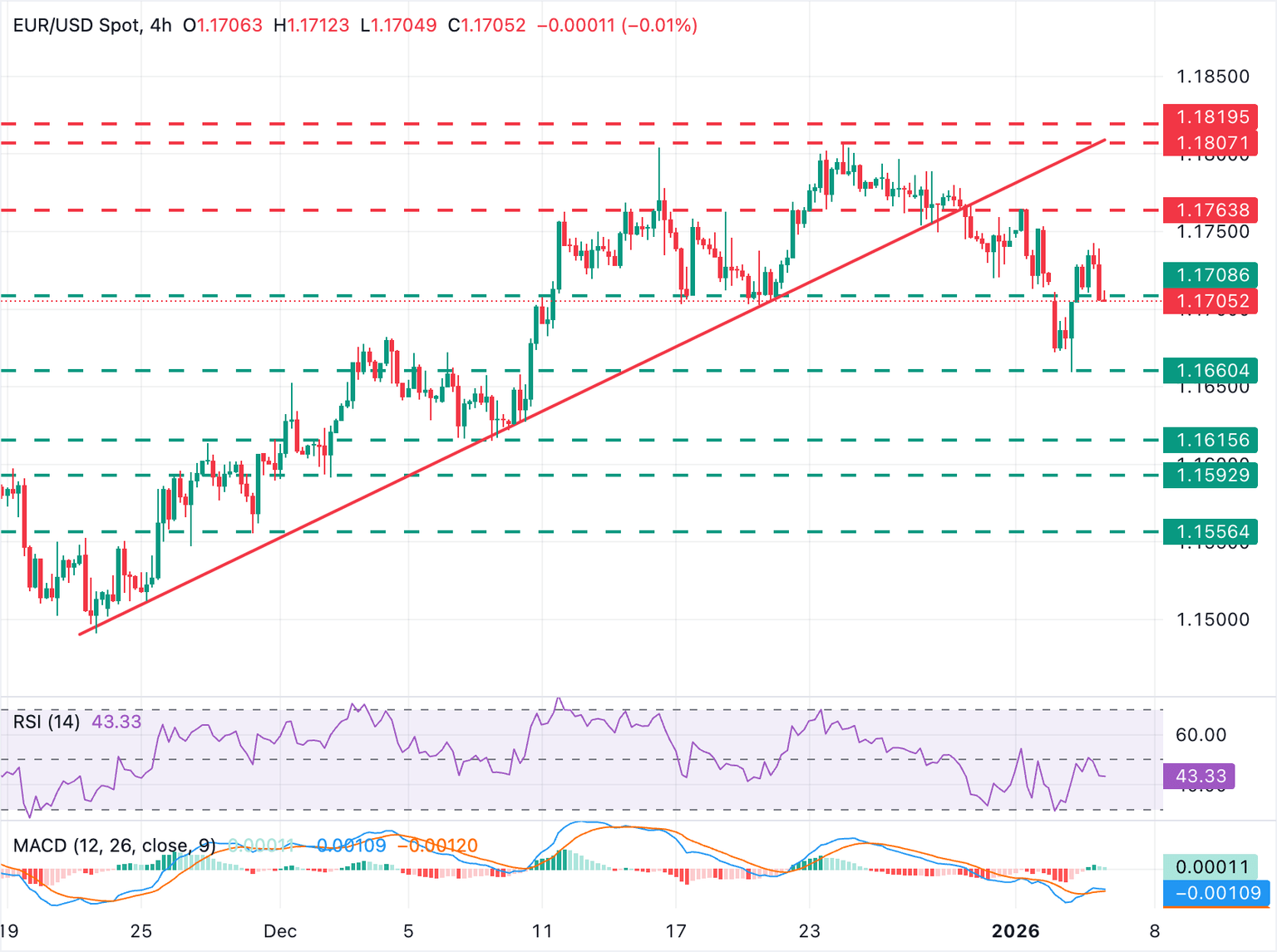
EUR/USD found support at the 1.1670 area on Monday but failed to find significant acceptance above 1.1700. Technical indicators are mixed. The 4-hour Moving Average Convergence Convergence (MACD) line has crossed the signal line, highlighting improving momentum, but the Relative Strength Index (RSI) remains capped below the 50 level in neutral to negative territory.
Session lows near 1.1710 maintain the downtrend for now, ahead of Monday’s low at 1.1660. In the event of a further decline, the next target is at the lows of December 8 and 9, at the 1.1615 area.
On the upside, the session high of 1.1740 closes the way towards the January 2 high of 1.1765. Further upside when the reversal trend line meets the December high, at 1.1808, is likely to be significant resistance.
Economic indicator
Consolidated consumer price index (annual)
Harmonized Index of Consumer Prices (HICP), issued by the German Statistical Office Destatis On a monthly basis, it is an indicator of inflation based on a statistical methodology that has been harmonized across all EU member states to facilitate comparisons. The annual reading compares prices in the reference month to the previous year. In general, a high reading is considered bullish for the Euro (EUR), while a low reading is considered bearish.
Read more.
Next release:
Tuesday 06 January 2026, at 1:00 p.m. (previous)
repetition:
monthly
consensus:
2.2%
former:
2.6%
Economic indicator
Consolidated consumer price index (monthly)
Harmonized Index of Consumer Prices (HICP), issued by the German Statistical Office Destatis On a monthly basis, it is an indicator of inflation based on a statistical methodology that has been harmonized across all EU member states to facilitate comparisons. The monthly figure compares commodity prices in the reference month with the previous month. In general, a high reading is considered bullish for the Euro (EUR), while a low reading is considered bearish.
Read more.
Next release:
Tuesday 06 January 2026, at 1:00 p.m. (previous)
repetition:
monthly
consensus:
0.4%
former:
-0.5%