
Gold (XAU/USD) maintains its bidding tone ahead of the European session and is currently trading near a one-and-a-half-week high, which was touched earlier on Wednesday. Traders boosted their bets on another interest rate cut by the US Federal Reserve after the US producer price index, released on Tuesday, indicated signs of slowing inflation. Moreover, several Fed officials supported the case for further policy easing, pushing the US dollar to a one-week low and acting as a tailwind for the non-yielding yellow metal.
At the same time, the prospect of lower US interest rates boosts investors’ appetite for riskier assets. Moreover, hopes for a peace deal between Russia and Ukraine remain supportive of the upbeat mood in global stock markets, holding back traders from fresh bullish bets on safe-haven gold. However, the fundamental backdrop suggests that the path of least resistance for XAU/USD remains bullish. Therefore, any corrective pullback is likely to be bought and remain limited.
Daily Summary Market Drivers: Gold continues to attract support from dovish Fed outlook and weak US dollar
- The latest numbers from the Bureau of Labor Statistics on Tuesday showed that the U.S. producer price index rose 2.7% in September from a year earlier, slightly higher than the previous 2.6% and broadly in line with expectations. Excluding food and energy, the core index rose 2.9% over the year compared to expectations of 2.7% and the 2.8% increase recorded in August.
- Separately, the US Census Bureau reported that retail sales rose 0.2% month-over-month in September. The reading was below the consensus estimate for growth of 0.4% and follows a 0.6% increase in August. In addition, the Conference Board’s Consumer Confidence Index fell to its lowest level in seven months in November amid concerns about a slowing labor market.
- Meanwhile, New York Fed President John Williams said last Friday that interest rates could fall in the near term without jeopardizing the central bank’s inflation target. Furthermore, Fed Governor Christopher Waller said earlier this week that the labor market is weak enough to warrant another quarter-point rate cut at the December meeting.
- Governor Stephen Meeran echoed the dovish view and said in a television interview on Tuesday that the deteriorating labor market and economy called for deep interest rate cuts to make monetary policy neutral. Traders reacted quickly and now estimate a roughly 85% probability that the US central bank will cut borrowing costs by 25 basis points next month.
- The US dollar fell to its lowest level in almost a week in the wake of somewhat mediocre data, which was delayed in the wake of the longest US government shutdown on record, and a rise in the Federal Reserve’s dovish bets. This in turn helps zero-yielding gold regain some positive momentum during the Asian session on Wednesday, after two-way price action the previous day.
- President Volodymyr Zelensky said on Tuesday that Ukraine is ready to advance a US-backed framework to end the war with Russia. Moreover, US President Donald Trump backed down from imposing any deadline for reaching a peace agreement, and said that his special envoy, Steve Witkoff, will travel to Moscow to meet with Russian President Vladimir Putin next week.
- Traders now look ahead to Wednesday’s US economic docket – which includes the delayed release of durable goods orders, along with the usual initial weekly jobless claims and Chicago PMI. Aside from this, comments from influential FOMC members will play a major role in driving demand for the US dollar and providing short-term opportunities around XAU/USD.
The constructive technical setup for gold supports the case of a move towards reclaiming the $4,200 level
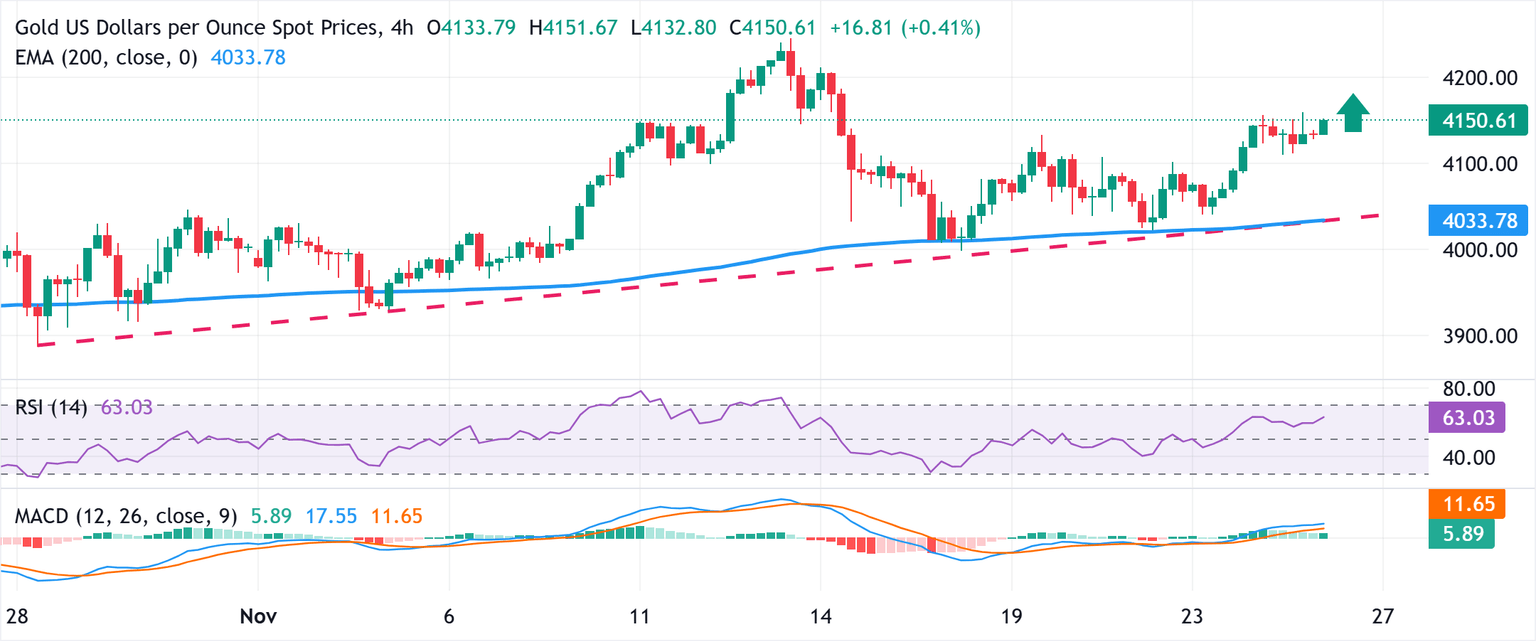
The commodity defended confluence support last week – which includes the 200-period Exponential Moving Average (EMA) on the 4-hour chart and an upward trend line extending from late October. The subsequent upward move, combined with positive oscillators on the daily 4-hour chart, support the case for further upward movement in the near term. Some subsequent buying after the overnight swing high, around the $4,159 area, will reaffirm the positive outlook and lift the gold price to the medium hurdle $4,177-4,178 on its way to the round $4,200 figure. Continued strength after the recent one will pave the way for an extension of momentum towards a test of the monthly swing high, around the $4,245 area.
On the flip side, any pullback may continue to find good support near the $4110-4100 area. A convincing break below the latter would expose the aforementioned confluence zone, currently held near the $4034-4033 area, below which the gold price could fall to the psychological $4000 level. Some subsequent selling could shift the bias in favor of bearish traders and pave the way for a decline towards last week’s swing lows, around the $3968-3967 area. XAU/USD could extend the decline further towards the $3,931 area, the $3,900 mark, and the late October low, around the $3,886 area.
US dollar price this week
The table below shows the percentage change in the US Dollar (USD) against the major currencies listed this week. The US dollar was the strongest against the Canadian dollar.
| US dollars | euro | GBP | JPY | Canadian | Australian dollar | New Zealand dollar | Swiss franc | |
|---|---|---|---|---|---|---|---|---|
| US dollars | -0.69% | -0.72% | -0.33% | -0.23% | -0.80% | -1.38% | -0.54% | |
| euro | 0.69% | -0.03% | 0.38% | 0.46% | -0.13% | -0.70% | 0.17% | |
| GBP | 0.72% | 0.03% | 0.39% | 0.50% | -0.09% | -0.67% | 0.20% | |
| JPY | 0.33% | -0.38% | -0.39% | 0.10% | -0.54% | -1.19% | -0.19% | |
| Canadian | 0.23% | -0.46% | -0.50% | -0.10% | -0.59% | -1.16% | -0.32% | |
| Australian dollar | 0.80% | 0.13% | 0.09% | 0.54% | 0.59% | -0.57% | 0.31% | |
| New Zealand dollar | 1.38% | 0.70% | 0.67% | 1.19% | 1.16% | 0.57% | 0.88% | |
| Swiss franc | 0.54% | -0.17% | -0.20% | 0.19% | 0.32% | -0.31% | -0.88% |
The heat map shows the percentage changes in major currencies versus each other. The base currency is chosen from the left column, while the counter currency is chosen from the top row. For example, if you select USD from the left column and move along the horizontal line to the Japanese Yen, the percentage change displayed in the box will represent USD (base)/JPY (quote).