
The Japanese Yen (JPY) built on its strong intraday gains and rose to a two-week high against a broadly weaker US Dollar (USD) during the first half of the European session on Monday. Recent comments from Bank of Japan (BoJ) Governor Kazuo Ueda have confirmed bets on an imminent interest rate hike, pushing Japanese government bond (JGB) yields to their highest levels in years. The narrowing of the interest rate differential between Japan and other major economies has provided a good boost to the Japanese yen.
Beyond this, the generally weaker tone in equity markets is seen as another factor benefiting the Japanese yen’s safe-haven status. On the other hand, the US dollar fell to its lowest level in two weeks amid dovish Fed expectations and contributes to the USD/JPY pair falling during the day below the mid-155.00 areas. Traders are now looking to key US economic releases this week, due at the start of a new month, starting with the ISM Manufacturing PMI later today, for fresh momentum.
The Japanese yen remains supported by rising Bank of Japan bets on raising interest rates
- Bank of Japan Governor Kazuo Ueda reiterated Monday that the central bank remains on track to raise interest rates further if prices and the economy continue to perform as expected. Ueda added that the probability of achieving the Bank of Japan’s base scenario for growth and inflation is gradually increasing.
- This reaffirms market bets on the Bank of Japan raising interest rates, either in December or January, and lifts the interest rate-sensitive two-year Japanese government bond yield to 1% for the first time since June 2008. Furthermore, the 20-year bond yield has risen to levels not seen since November 2020 and is lifting the low-yielding Japanese yen.
- Japan’s Ministry of Finance reported earlier today that capital spending rose for the third straight quarter, 2.9% from a year earlier during the July-September quarter. However, this represents a notable slowdown from the 7.6% rise recorded in the previous quarter, although it does not affect the Japanese yen much.
- Japan’s 2025 Composite PMI reading finished at 52.0 for November, up from 51.5 the previous month. This indicates modest growth in the private sector overall due to a combination of a slow decline in factory activity, which contracted for the fifth month in a row, and continued growth in services.
- Meanwhile, Japanese Prime Minister Sanae Takaishi promised to continue fiscal management, paying close attention to interest rate trends and other factors. This, coupled with a selling bias in the US Dollar (USD), is putting some downward pressure on the USD/JPY pair during the Asian session.
- Recent dovish statements by several Federal Reserve officials have raised market bets for another rate cut in December. This in turn drags the US Dollar Index (DXY), which tracks the US currency against a basket of currencies, to its lowest level in almost two weeks and weighs on the USD/JPY pair.
- Traders are now looking to the US ISM Manufacturing PMI release for some momentum later during the North American session. Moreover, important US economic releases this week, scheduled at the beginning of a new month, will play a major role in influencing the US dollar and USD/JPY.
USD/JPY looks weak; A break below the 100-SMA on H4 starts to take effect
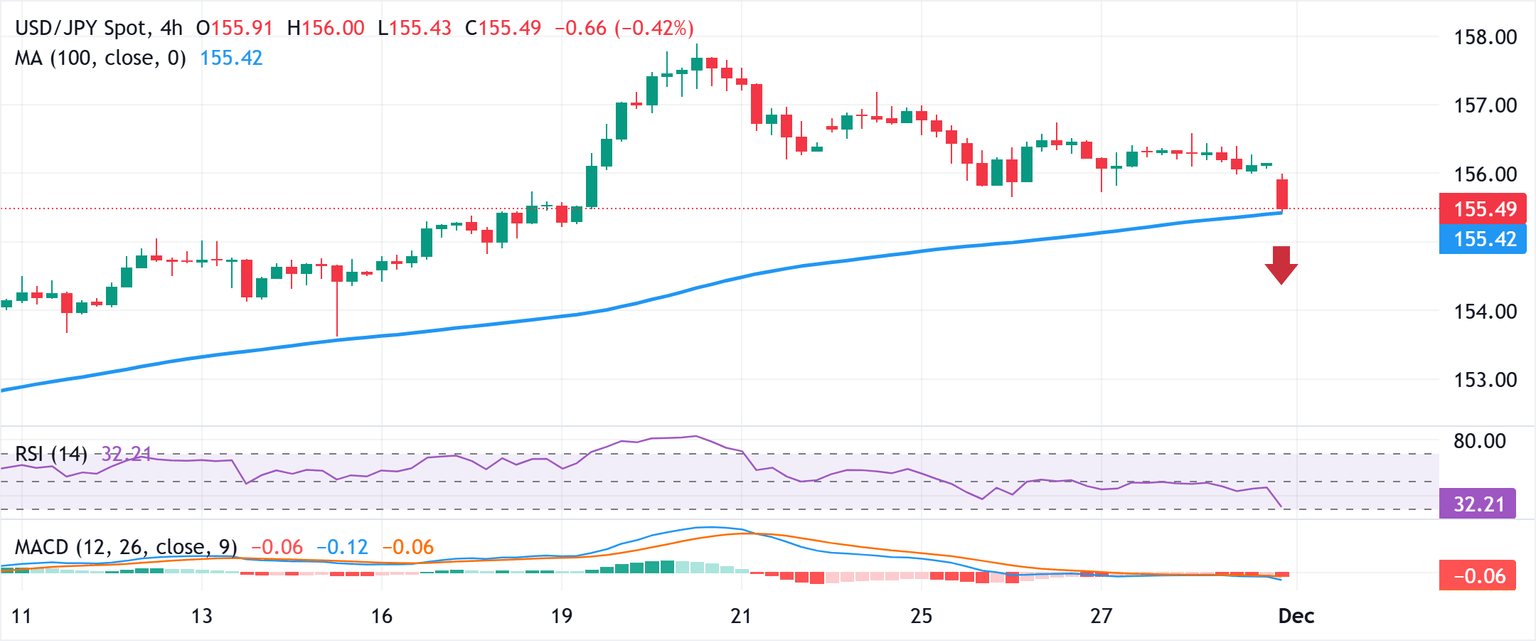
The bearish move now awaits a sustained breakout below the 155.40-155.35 zone, which represents the 100-period simple moving average (SMA) on the 4-hours chart. At the same time, the oscillators on the mentioned chart are gaining negative momentum, although the technical indicators on the daily chart are still holding in positive territory. This, in turn, indicates that the USD/JPY pair is likely to find good support near the psychological level of 155.00. However, some subsequent selling will confirm the breakdown and pave the way for an extension of the one-week-old downtrend.
On the flip side, any meaningful recovery attempt may now face an immediate hurdle before the round figure of 156.00. Sustained strength after that could see short covering move towards the 156.65-156.70 area, above which USD/JPY could reclaim the 157.00 mark. Momentum could extend further towards the intermediate hurdle 157.45-157.50 on its way to a multi-month high, around the 158.00 area, reached in November.
Japanese yen price today
The table below shows how much the Japanese Yen (JPY) has changed against the major currencies listed today. The Japanese yen was the strongest against the British pound.
| US dollars | euro | GBP | JPY | Canadian | Australian dollar | New Zealand dollar | Swiss franc | |
|---|---|---|---|---|---|---|---|---|
| US dollars | -0.15% | 0.22% | -0.59% | 0.08% | 0.03% | 0.04% | -0.05% | |
| euro | 0.15% | 0.37% | -0.36% | 0.23% | 0.17% | 0.19% | 0.10% | |
| GBP | -0.22% | -0.37% | -0.74% | -0.14% | -0.19% | -0.18% | -0.27% | |
| JPY | 0.59% | 0.36% | 0.74% | 0.60% | 0.54% | 0.56% | 0.47% | |
| Canadian | -0.08% | -0.23% | 0.14% | -0.60% | -0.05% | -0.03% | -0.13% | |
| Australian dollar | -0.03% | -0.17% | 0.19% | -0.54% | 0.05% | 0.02% | -0.05% | |
| New Zealand dollar | -0.04% | -0.19% | 0.18% | -0.56% | 0.03% | -0.02% | -0.10% | |
| Swiss franc | 0.05% | -0.10% | 0.27% | -0.47% | 0.13% | 0.05% | 0.10% |
The heat map shows the percentage changes in major currencies versus each other. The base currency is chosen from the left column, while the counter currency is chosen from the top row. For example, if you select the Japanese Yen from the left column and move along the horizontal line to the US Dollar, the percentage change displayed in the box will represent the Japanese Yen (base)/US Dollar (quote).