
The Japanese yen (JPY) remains ahead against the broadly weaker US dollar during the early European session on Wednesday, despite its lack of bullish conviction. Japan’s corporate goods price index beat expectations and reaffirmed bets on an imminent interest rate hike by the Bank of Japan. This, combined with a cautious market mood, is helping the safe-haven Japanese yen recover slightly from a two-week low, which it touched against its US counterpart on Tuesday.
However, concerns about Japan’s expansionary fiscal measures and growth concerns are preventing JPY bulls from placing new bets. Investors also appear hesitant and are choosing to wait for the results of the two-day Federal Open Market Committee meeting later today to get more signals on the path of future interest rate cuts. Meanwhile, bets on further interest rate cuts by the Fed are keeping the US dollar low near its lowest level since late October and may continue to act as a headwind for the USD/JPY pair.
The Japanese yen is struggling to capitalize on modest intraday upward movement despite the Bank of Japan’s hawkish bets
- Data published by the Bank of Japan on Wednesday showed that the corporate goods price index rose 2.7% year-on-year in October, down slightly from 2.8% in the previous month. The data, although in line with consensus estimates, indicated that inflation in Japan remains well above historical levels.
- Moreover, Bank of Japan Governor Kazuo Ueda reiterated on Tuesday that the likelihood of the central bank’s economic forecasts and core price forecasts being realized is gradually increasing. This supports the case for further BOJ policy normalization and provides some support to the Japanese yen during the Asian session.
- Ueda added that the Bank of Japan plans to increase purchases of government bonds if long-term interest rates rise sharply. In fact, the yield on Japan’s benchmark 10-year government bond reached an 18-year high this week on the back of Japanese Prime Minister Sanae Takaishi’s big spending plans to boost sluggish growth.
- Japan’s revised GDP report released this week revealed that the economy contracted by 0.6% in the third quarter compared to an initial estimate of 0.4%. On an annual basis, the economy contracted by 2.3%, or at its fastest pace since the third quarter of 2023, versus a decline of 2.0% expected and 1.8% originally.
- However, traders still expect a greater than 75% chance that the Bank of Japan will raise interest rates at the next policy meeting on December 18-19. This represents a significant divergence compared to expectations for further policy easing by the US Federal Reserve and benefits the lower-yielding Japanese yen.
- The US central bank is expected to cut borrowing costs by 25 basis points at the end of its two-day policy meeting later today. Therefore, traders will be examining the updated economic forecasts and Fed Chairman Jerome Powell’s comments during the post-meeting press conference for further signals on the path of future interest rate cuts.
- The outlook will play a major role in influencing USD price dynamics in the near term and will provide some beneficial momentum to the USD/JPY pair. Market attention will then turn to the Bank of Japan’s policy meeting next week, which should help determine the next phase of the currency pair’s directional movement.
USD/JPY’s bullish bias appears intact; An overnight break through the confluence at 155.30 remains in place
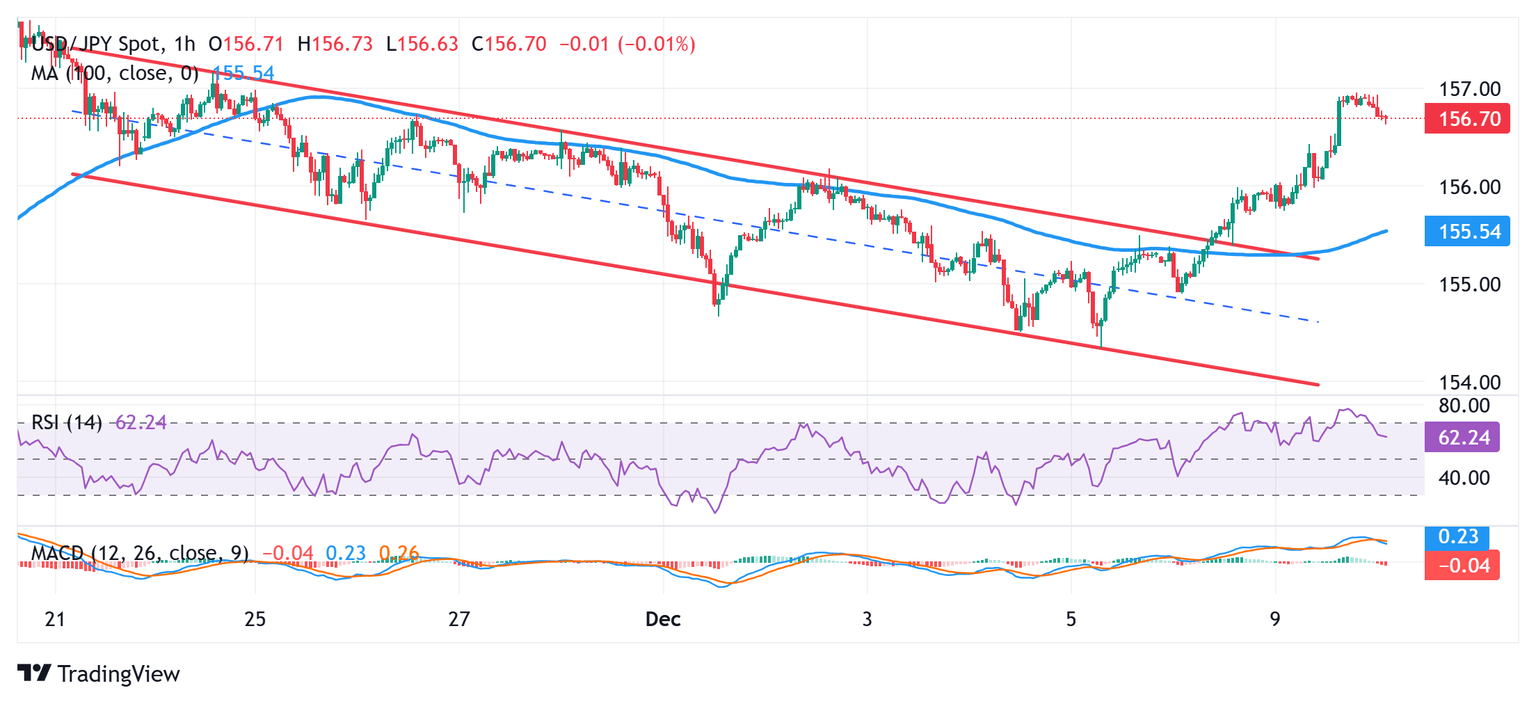
An overnight breakout through the 155.30 confluence zone — which includes the 100 hourly simple moving average (SMA) and the upper end of a short-term downtrend channel — was a major catalyst for the USD/JPY rally. Moreover, the oscillators on the hourly and daily charts are holding in positive territory and supporting the case for further upward movement in the near term. Some subsequent buying after the round 157.00 figure will reaffirm constructive expectations and lift spot prices to the intermediate hurdle of 157.45 on the way to the 158.00 area, or multi-month peak, reached in November.
On the other hand, any further decline towards 156.00 could be considered a buying opportunity. This in turn should limit the downside of USD/JPY near the 155.35-155.30 confluence, which has now turned into support. However, some subsequent selling, leading to subsequent weakness below the 155.00 psychological level, may negate the positive outlook and shift the near-term bias in favor of bearish traders.
Economic indicator
Federal interest rate decision
the Federal Reserve The Federal Reserve deliberates on monetary policy and decides on interest rates at eight pre-scheduled meetings annually. It has two mandates: keeping the inflation rate at 2%, and maintaining full employment. Its main tool for achieving this end is setting interest rates – at which banks lend and banks lend to each other. If it decides to raise interest rates, the US dollar (USD) tends to strengthen because it attracts more foreign capital inflows. If they lower interest rates, they tend to weaken the US dollar while draining capital to countries that offer higher returns. If interest rates are left unchanged, attention turns to the tone of the FOMC statement, and whether it is hawkish (expecting interest rates to rise in the future), or dovish (expecting interest rates to fall in the future).
Read more.
Next release:
Wednesday 10 December 2025 at 19:00
repetition:
irregular
consensus:
3.75%
former:
4%
source:
Federal Reserve