
The Japanese Yen (JPY) maintains its bullish bias during the early European session on Monday, although it lacks bullish conviction amid a range of mixed forces. Rising tensions between the United States and Venezuela, coupled with concerns about renewed conflict between Israel and Iran and lingering uncertainties stemming from the long war between Russia and Ukraine, support the safe-haven status of the Japanese yen. Furthermore, comments made by Atsushi Mimura, Japan’s chief foreign exchange official, fueled speculation about possible government intervention and provided an additional boost to the Japanese yen.
Meanwhile, Bank of Japan Governor Kazuo Ueda left the door open for further tightening, although he remained vague on the exact timing and pace of future interest rate hikes. In addition, concerns about Japan’s deteriorating financial situation, exacerbated by the recent sharp rise in Japanese government bond (JGB) yields, limited the yen’s gains. However, a modest decline in the US Dollar (USD) keeps USD/JPY low below the mid-157.00 areas and calls for caution before taking positions to extend Friday’s post-BOJ rally to the 158.00 area, or a multi-month peak reached in November.
The Japanese yen holds onto gains amid rebounding safe-haven demand and intervention fears
- Atsushi Mimura, Japan’s deputy finance minister for international affairs and chief foreign exchange official, said Monday he was concerned about one-way moves and warned of taking appropriate measures against an excessive decline in the Japanese yen.
- The United States intercepted a Venezuelan oil tanker over the weekend and is actively pursuing a third tanker in less than two weeks. This comes after US President Donald Trump last week ordered a blockade on sanctioned tankers entering and leaving Venezuela.
- Israeli Prime Minister Benjamin Netanyahu said officials are concerned that Iran is rebuilding nuclear enrichment sites and are preparing to brief Trump on options for attacking the missile program again, NBC News reported Saturday.
- Russian President Vladimir Putin’s top foreign policy aide said on Sunday that the changes made by the Europeans and Ukraine to the American proposals did not improve the chances of peace. This contributes to driving safe flows towards the Japanese yen.
- The Bank of Japan, as widely expected, raised interest rates to 0.75%, or the highest level in 30 years, at the end of its December meeting on Friday and reiterated that it would continue raising interest rates if the economy and prices move in line with expectations.
- In the press conference following the meeting, Bank of Japan Governor Kazuo Ueda said the central bank will look closely at the impact of the recent interest rate change, and the pace of monetary adjustment will depend on the economic, price and financial outlook.
- However, Ueda did not provide any clarity on future increases. Moreover, concerns about Japan’s deteriorating financial health – led by a sharp rise in Japanese government bond yields and Prime Minister Sanae Takaishi’s spending plan – may limit the yen’s gains.
- Recent hawkish comments from influential Federal Reserve officials pushed the US dollar to a one-week high on Friday and should help limit any significant USD/JPY corrective decline, calling for bear caution.
- In fact, Cleveland Fed President Beth Hammack said monetary policy is in a good place to pause and assess the effects of 75 basis point rate cuts on the economy during the first quarter, Bloomberg reported Sunday.
- However, traders are still anticipating a higher likelihood of the US central bank cutting interest rates two more times in 2026. This keeps a lid on another move higher for the US dollar ahead of the US third-quarter GDP growth figures on Thursday.
USD/JPY needs to weaken below 157.00 to support the case for any further losses
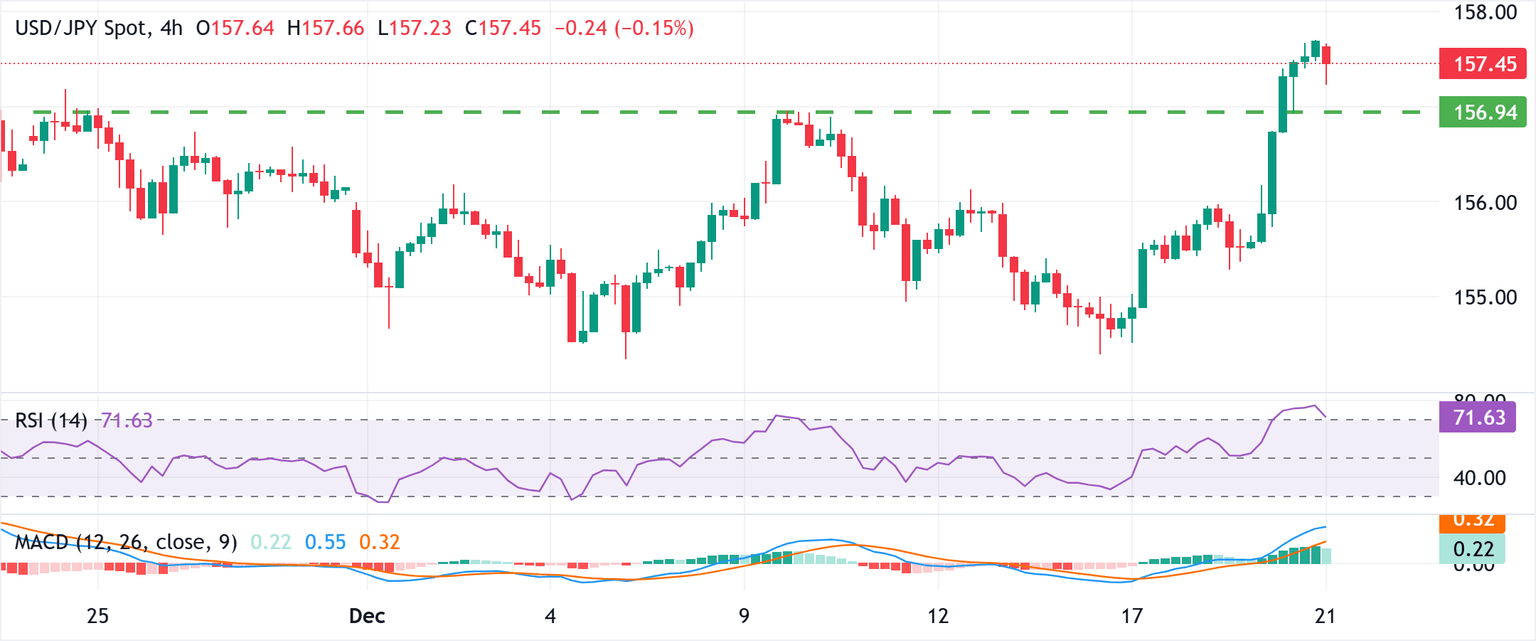
The breakout of the 156.95-157.00 horizontal barrier on Friday was seen as a new incentive for USD/JPY bulls. Moreover, the oscillators on the daily chart are gaining positive momentum and are still far from the overbought zone. This, in turn, indicates that any subsequent decline is likely to attract new buyers near the mentioned resistance point. However, some subsequent buying could pave the way for deeper losses towards the 155.50 intermediate support level on the way to the 155.00 psychological mark. The latter should act as a major pivot point, which, if broken, may shift the bias in favor of bearish traders.
On the flip side, the bulls may wait for a sustained move beyond the 157.85-157.90 area, or a multi-month high, before placing new bets. The USD/JPY pair may then accelerate the positive move towards the next relevant hurdle near the 158.45 area before aiming to challenge the high of the year so far, around the 159.00 area, reached in January.
Frequently asked questions about the Japanese Yen
The Japanese Yen (JPY) is one of the most widely traded currencies in the world. Their value is determined broadly by the performance of the Japanese economy, but more specifically by the Bank of Japan’s policy, the spread between Japanese and US bond yields, or risk sentiment among traders, among other factors.
One of the powers of the Bank of Japan is to control the currency, so its movements are key to the yen. The Bank of Japan has intervened directly in currency markets on occasion, generally to devalue the yen, although it often refrains from doing so due to the political concerns of its major trading partners. The Bank of Japan’s ultra-loose monetary policy between 2013 and 2024 caused the yen to depreciate against its major counterparts due to the growing policy divergence between the Bank of Japan and other major central banks. More recently, the gradual dismantling of this ultra-lenient policy has given the yen some support.
Over the past decade, the Bank of Japan’s ultra-loose monetary policy stance has led to widening policy divergence with other central banks, especially the US Federal Reserve. This supported the widening of the spread between the US and Japanese 10-year bonds, which favored the US dollar against the Japanese yen. The Bank of Japan’s decision in 2024 to gradually abandon ultra-loose policy, along with interest rate cuts at other major central banks, are narrowing this spread.
The Japanese yen is often viewed as a safe investment. This means that in times of market stress, investors are more likely to put their money into the Japanese currency because of its supposed reliability and stability. Turbulent times are likely to strengthen the value of the yen against other currencies that are considered riskier to invest in.