NZD/USD gained some positive momentum on Thursday and is recovering part of the previous day’s heavy losses to the lowest level since April 9. Spot prices are holding on to intraday gains above the 0.5600 mark during the early European session, although continued buying of the US Dollar (USD) may cap the upside ahead of the delayed release of the US Non-Farm Payrolls (NFP) report for September.
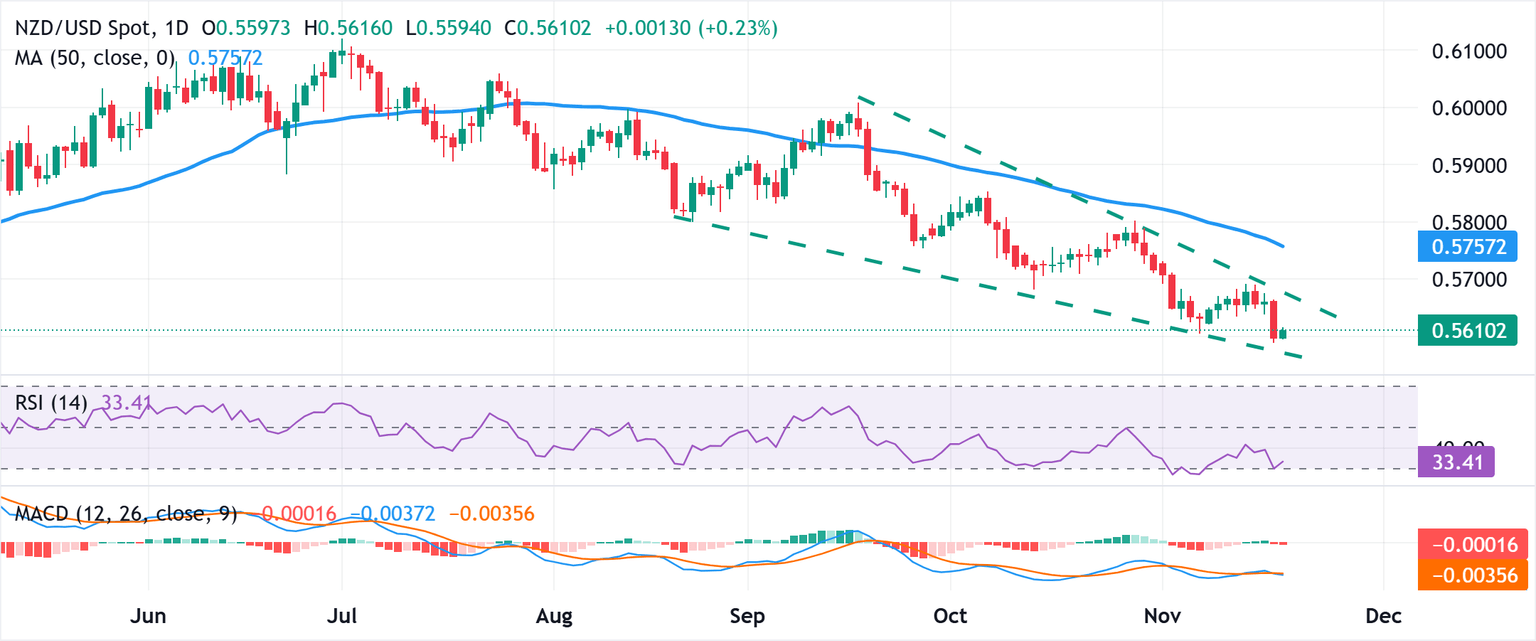
Technically, the recent decline we have seen over the past two months or so along two converging trend lines forms a bullish falling wedge formation on the daily chart. However, recent repeated failures to build on the move beyond the 50-day Simple Moving Average (SMA) and negative oscillators warrant some caution before positioning for any further near-term upside move for NZD/USD.
Meanwhile, any subsequent upward move is likely to encounter a strong barrier near the 0.5665-0.5670 area, which represents the upper border of the falling wedge. Some subsequent buying could trigger short covering and lift NZD/USD to the 0.5700 mark on its way to 50-day SMA pivot resistance, currently pinned near the 0.5765 area. A sustained move after the last one will confirm that spot prices have bottomed.
On the flip side, acceptance below the 0.5600 round figure and subsequent breakout of the falling wedge support, around the 0.5570-0.5565 area, will be seen as a fresh catalyst for bearish traders. The NZD/USD pair may then accelerate the decline towards testing levels below the 0.5500 psychological mark, or the multi-year low it reached in April, and extend an almost four-month downtrend.
NZD/USD daily chart
Frequently asked questions about the New Zealand dollar
The New Zealand Dollar (NZD), also known as the Kiwi, is a popular currency among investors. Its value is widely determined by the health of the New Zealand economy and the policy of the country’s central bank. However, there are some unique characteristics that could make the New Zealand dollar move as well. The performance of the Chinese economy tends to move the New Zealand dollar because China is New Zealand’s largest trading partner. Bad news for the Chinese economy will likely mean New Zealand’s exports to the country will decline, affecting the economy and therefore its currency. Another factor that affects the New Zealand dollar is dairy prices as the dairy industry is New Zealand’s main export. Higher dairy prices boost export income, which contributes positively to the economy and therefore the New Zealand dollar.
The Reserve Bank of New Zealand (RBNZ) aims to achieve and maintain inflation between 1% and 3% over the medium term, with a focus on keeping it near the 2% midpoint. To this end, the Bank sets an appropriate level of interest rates. When inflation is very high, the Reserve Bank of New Zealand will increase interest rates to cool the economy, but this move will also cause bond yields to rise, making it more attractive for investors to invest in the country and thus strengthening the New Zealand dollar. Conversely, low interest rates tend to weaken the New Zealand dollar. The so-called spread, or how New Zealand’s interest rates compare or are expected to compare to those set by the US Federal Reserve, can also play a major role in moving the NZD/USD pair.
New Zealand’s macroeconomic data releases are key to assessing the state of the economy and can influence the valuation of the New Zealand Dollar (NZD). A strong economy, based on high economic growth, low unemployment, and high confidence, is good for the New Zealand dollar. High economic growth attracts foreign investment and may encourage the Reserve Bank of New Zealand to increase interest rates, if this economic strength is accompanied by higher inflation. Conversely, if economic data is weak, the value of the New Zealand dollar is likely to decline.
The New Zealand Dollar (NZD) tends to strengthen during periods of risk, or when investors view broader market risks as low and are optimistic about growth. This tends to lead to a more positive outlook for commodities and so-called “commodity currencies” such as the New Zealand. Conversely, the New Zealand dollar tends to weaken in times of market turmoil or economic uncertainty as investors tend to sell riskier assets and flee to more stable safe havens.