Silver price (XAG/USD) continues its winning streak for the fourth trading day on Wednesday. The white metal rose to nearly $90.00 during the Asian trading session as demand for safe haven assets remained steady amid geopolitical tensions.
Civil unrest in Iran as the public demands political change due to high inflation, the decline of the rial against the US dollar, and government corruption has led to the deaths of hundreds of protesters.
In response, US President Donald Trump warned of military action in Tehran if the government continues to kill protesters.
Meanwhile, growing concerns about the independence of the Federal Reserve (Fed), in the wake of criminal charges against Chairman Jerome Powell over mismanagement of funds earmarked for the Washington headquarters renovation, which he called a “pretext”, the result of the Fed setting interest rates based on its assessment of the public interest rather than the president’s preferences, have kept safe-haven assets at the forefront.
This event led to a sharp decline in the US dollar, as market experts warned that the attack on the Federal Reserve’s independent status could affect the US sovereign rating. However, the US dollar rebounded quickly after global central bank heads backed Fed Chairman Powell over his dispute with President Trump.
“We stand in full solidarity with the Federal Reserve System and its Chairman Jerome Powell,” the heads of the European Central Bank (ECB), the Bank of England (BoE) and nine other institutions said collectively on Tuesday.
Technical analysis of silver
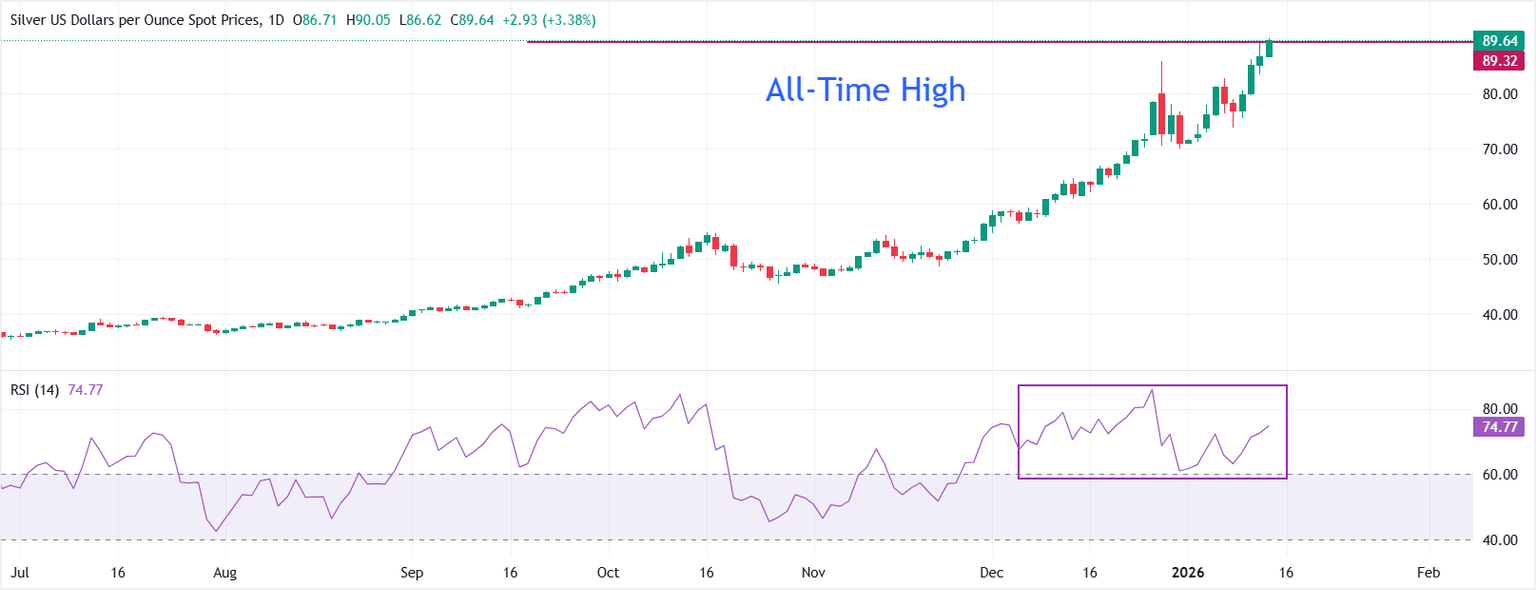
XAG/USD is trading higher near $90.00 as of writing. The advance remains steady, with buyers maintaining control as momentum extends into overbought territory.
The 14-day Relative Strength Index (RSI) at 74.77 (overbought) and rise from 72.52 confirms strengthening bullish pressure. While the bias is pointing upward, extended conditions can limit follow-through and enhance consolidation.
A moderation in momentum with the RSI retreating towards 70 should help reset the move and support a more consistent move. Conversely, a renewed acceleration in the RSI towards the previous maximum near 85.90 would leave the rally vulnerable to a sharper pullback as momentum fatigue increases.
(The technical analysis for this story was written with the help of an artificial intelligence tool.)
Frequently asked questions about silver
Silver is a precious metal that is widely traded among investors. It has been used historically as a store of value and medium of exchange. Although less popular than gold, traders may turn to silver to diversify their investment portfolio, for its intrinsic value or as a potential hedge during periods of high inflation. Investors can buy physical silver, in the form of coins or bullion, or trade it through instruments such as exchange-traded funds, which track its price in international markets.
Silver prices can move due to a wide range of factors. Geopolitical instability or fears of a deep recession could cause the price of silver to rise due to its safe-haven status, although to a lesser extent than the price of gold. As a non-yielding asset, silver tends to rise as interest rates fall. Its movements also depend on how the US dollar (USD) behaves as the asset is priced in dollars (XAG/USD). A strong dollar tends to keep the price of silver at bay, while a weak dollar is likely to push prices higher. Other factors such as investment demand, mining supplies – silver is more plentiful than gold – and recycling rates can also influence prices.
Silver is widely used in industry, especially in sectors such as electronics or solar energy, as it has one of the highest electrical conductivity of all metals – more than copper and gold. A rise in demand can cause prices to rise, while a fall tends to bring them down. Dynamics in the economies of the United States, China and India can also contribute to price fluctuations: for the United States, and especially China, its large industrial sectors use silver in various processes; In India, consumer demand for the precious metal used in jewelery also plays a major role in determining prices.
Silver prices tend to follow gold movements. When gold prices rise, silver usually follows suit, as its status as a safe haven asset is similar. The gold/silver ratio, which shows how many ounces of silver are needed to equal the value of one ounce of gold, may help determine the relative valuation between the two metals. Some investors may consider a high ratio to be an indication that silver is undervalued, or that gold is undervalued. Conversely, a low ratio may indicate that gold is undervalued compared to silver.