
Silver (XAG/USD) price extends a three-day recovery move to near $52.00 during the Asian trading session on Wednesday. The white metal is strengthening as yields on interest-bearing assets remain under pressure due to rising expectations that the Federal Reserve (Fed) may cut interest rates again this year.
At the time of writing, 10-year US Treasury yields were trading flat at around 4.00%, but they have fallen 3.4% in a week.
Lower yields on interest-bearing assets bode well for non-yielding assets, such as silver.
According to the CME FedWatch tool, the probability of the Fed cutting interest rates by 25 basis points to 3.50%-3.75% at the December meeting rose to 85.3% from 50.1% seen a week ago.
The Fed’s dovish outlook was prompted by New York President John Williams’ comments on Friday, which supported the need to ease monetary conditions further. “I see monetary policy as modestly constrained, although somewhat less so than before our recent actions,” Williams said, adding that there is room for further adjustment in the near term.
Meanwhile, Bloomberg headlines suggested that White House economic adviser Kevin Hassett had emerged as a front-runner to replace Fed Chairman Jerome Powell. It is possible that the entry of another nominee of US President Donald Trump, after Governor Stephen Meiran, into the Federal Open Market Committee (FOMC), will increase the odds of a faster monetary expansion cycle, given that Trump has been criticizing the central bank, especially Fed Chairman Powell, for keeping interest rates higher.
Technical analysis of silver
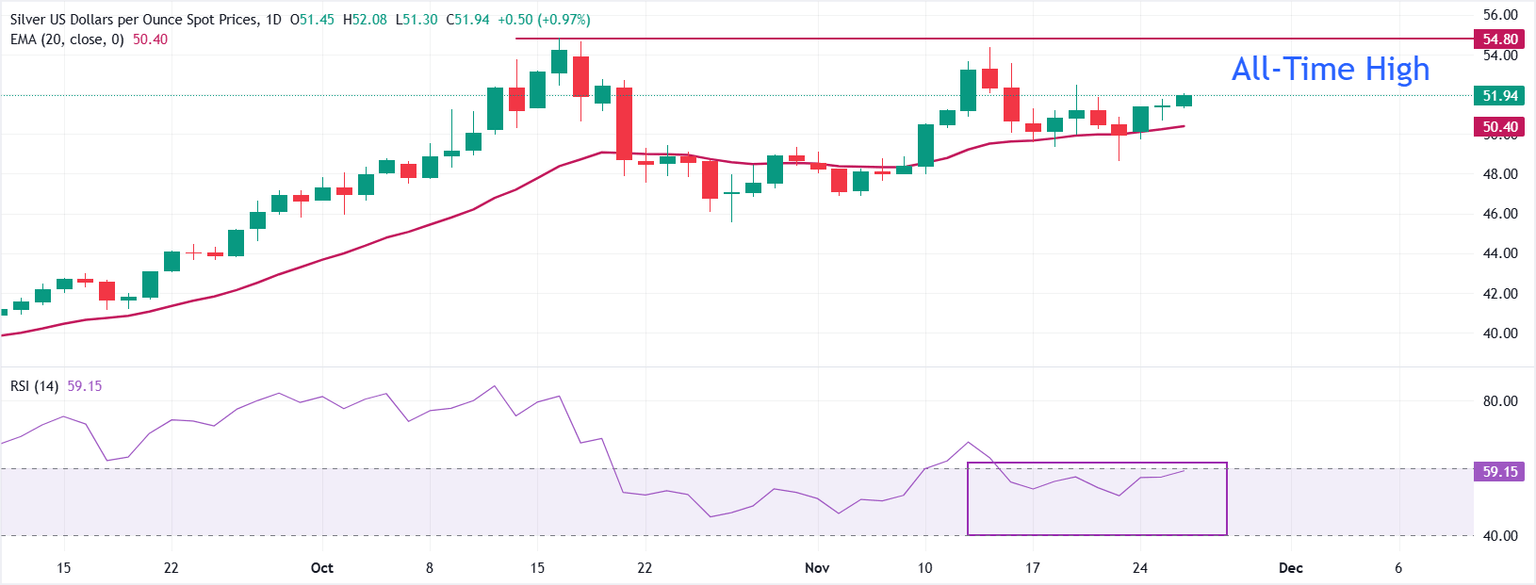
On the daily chart, XAG/USD is trading at $51.94. The 20-day EMA rises and the price stabilizes above it, reinforcing the bullish bias and improving the trend quality. The RSI remains at 59.15 above the neutral midline, confirming positive momentum without overbought pressure. Initial support is in line with the 20-day EMA at $50.40, suggesting declines can be contained.
The rising average continues to support the move, and a sustained close above it would keep the path of least resistance to the upside. If the RSI fades towards 50, momentum will cool and the market could turn to consolidation, with pullbacks expected to stabilize around the moving average.
Looking down, the September 23 high of $44.47 will remain a major support. On the upside, the all-time high at $54.50 could serve as a major barrier.
(Technical analysis of this story was written with the help of an artificial intelligence tool)
Silver daily chart
Frequently asked questions about silver
Silver is a precious metal that is widely traded among investors. It has been used historically as a store of value and medium of exchange. Although less popular than gold, traders may turn to silver to diversify their investment portfolio, for its intrinsic value or as a potential hedge during periods of high inflation. Investors can buy physical silver, in the form of coins or bullion, or trade it through instruments such as exchange-traded funds, which track its price in international markets.
Silver prices can move due to a wide range of factors. Geopolitical instability or fears of a deep recession could cause the price of silver to rise due to its safe-haven status, although to a lesser extent than the price of gold. As a non-yielding asset, silver tends to rise as interest rates fall. Its movements also depend on how the US dollar (USD) behaves as the asset is priced in dollars (XAG/USD). A strong dollar tends to keep the price of silver at bay, while a weak dollar is likely to push prices higher. Other factors such as investment demand, mining supplies – silver is more plentiful than gold – and recycling rates can also influence prices.
Silver is widely used in industry, especially in sectors such as electronics or solar energy, as it has one of the highest electrical conductivity of all metals – more than copper and gold. A rise in demand can cause prices to rise, while a fall tends to bring them down. Dynamics in the economies of the United States, China and India can also contribute to price fluctuations: for the United States, and especially China, its large industrial sectors use silver in various processes; In India, consumer demand for the precious metal used in jewelery also plays a major role in determining prices.
Silver prices tend to follow gold movements. When gold prices rise, silver usually follows suit, as its status as a safe haven asset is similar. The gold/silver ratio, which shows how many ounces of silver are needed to equal the value of one ounce of gold, may help determine the relative valuation between the two metals. Some investors may consider a high ratio to be an indication that silver is undervalued, or that gold is undervalued. Conversely, a low ratio may indicate that gold is undervalued compared to silver.