Silver (XAG/USD) fell on Wednesday after hitting a daily high of $95.56 after US President Donald Trump softened his tone in his speech in Davos, saying he was ready to negotiate Greenland with Denmark. At the time of writing, XAG/USD is trading at $93.57, down more than 1% after hitting a record high of $95.89 on Tuesday.
XAG/USD Price Forecast: Technical Outlook
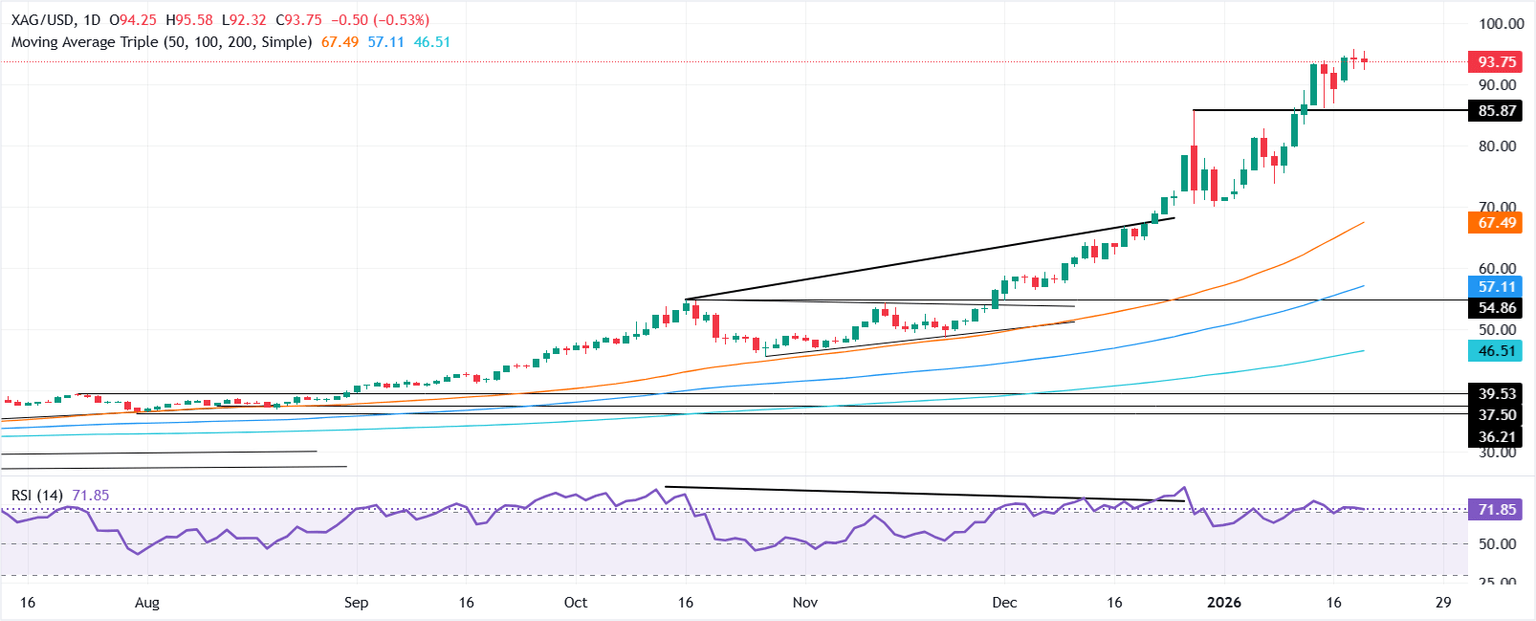
Silver’s daily chart indicates that the gray metal is biased higher, but the parabolic move appears to have paused as the Relative Strength Index (RSI) has broken out of overbought territory and shown signs of negative divergence.
Despite this, the bears are not out of the woods as they have to clear the $90.00 level before challenging the last session low of $86.45 reached on January 15. With this result, silver could fall towards the 20-day simple moving average at $80.63.
On the flip side, if XAG/USD extends its gains, buyers need to push prices above the record high at $95.89, followed by the $100.00 level.
XAG/USD Price Chart – Daily
(This story was corrected on 21 January at 17:11 to say in the first paragraph that $95.56 was a daily high, not an all-time high.)
Frequently asked questions about silver
Silver is a precious metal that is widely traded among investors. It has been used historically as a store of value and medium of exchange. Although less popular than gold, traders may turn to silver to diversify their investment portfolio, for its intrinsic value or as a potential hedge during periods of high inflation. Investors can buy physical silver, in the form of coins or bullion, or trade it through instruments such as exchange-traded funds, which track its price in international markets.
Silver prices can move due to a wide range of factors. Geopolitical instability or fears of a deep recession could cause the price of silver to rise due to its safe-haven status, although to a lesser extent than the price of gold. As a non-yielding asset, silver tends to rise as interest rates fall. Its movements also depend on how the US dollar (USD) behaves as the asset is priced in dollars (XAG/USD). A strong dollar tends to keep the price of silver at bay, while a weak dollar is likely to push prices higher. Other factors such as investment demand, mining supplies – silver is more plentiful than gold – and recycling rates can also influence prices.
Silver is widely used in industry, especially in sectors such as electronics or solar energy, as it has one of the highest electrical conductivity of all metals – more than copper and gold. A rise in demand can cause prices to rise, while a fall tends to bring them down. Dynamics in the economies of the United States, China and India can also contribute to price fluctuations: for the United States, and especially China, its large industrial sectors use silver in various processes; In India, consumer demand for the precious metal used in jewelery also plays a major role in determining prices.
Silver prices tend to follow gold movements. When gold prices rise, silver usually follows suit, as its status as a safe haven asset is similar. The gold/silver ratio, which shows how many ounces of silver are needed to equal the value of one ounce of gold, may help determine the relative valuation between the two metals. Some investors may consider a high ratio to be an indication that silver is undervalued, or that gold is undervalued. Conversely, a low ratio may indicate that gold is undervalued compared to silver.