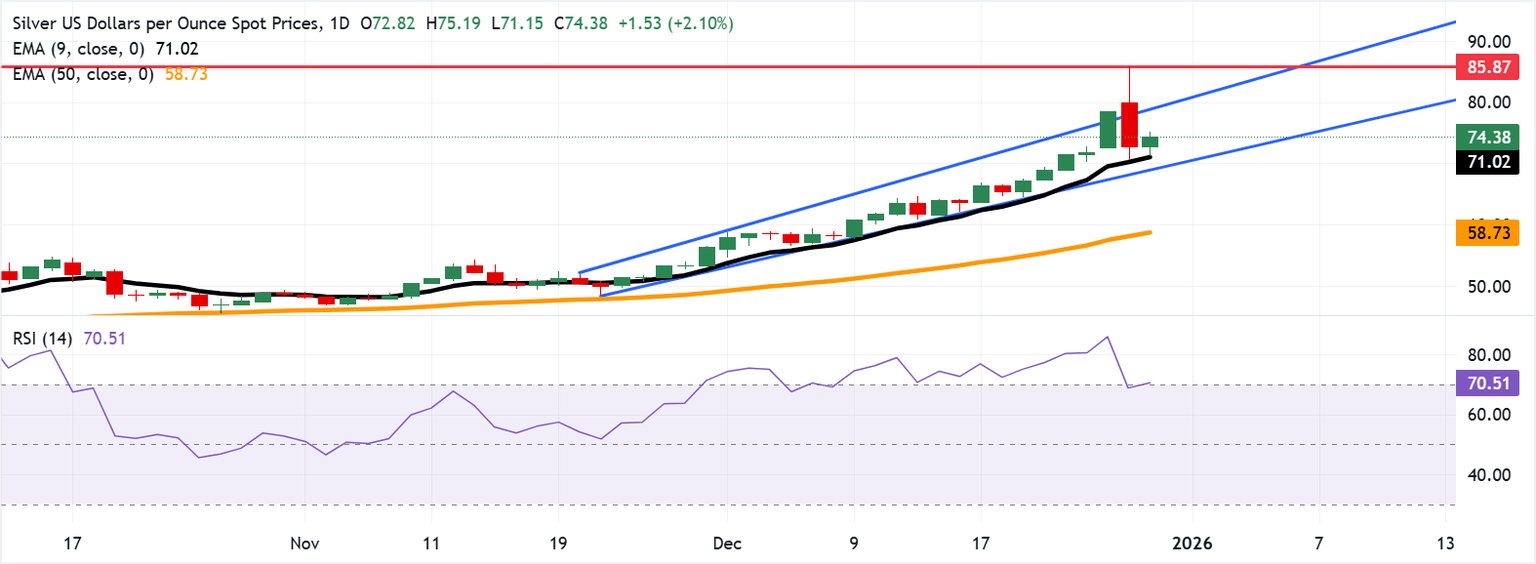
The price of silver (XAG/USD) rose more than 2% after recording a sharp decline of more than 7% in the previous session, trading around $74.40 per ounce during the early European hours on Tuesday. Traders engaged in aggressive profit taking after the XAG/USD pair reached a record high of $85.87 in the previous session.
Technical analysis of the daily chart time frame indicates that the price of the precious metal is moving upward within an ascending channel pattern, enhancing the bullish bias. The 14-day RSI stands at 70.51 (overbought), indicating extended momentum.
The nine-day Exponential Moving Average (EMA) rises above the 50-day EMA, and the price stabilizes above both, forming a strong uptrend. The slope of the short-term average has increased in recent sessions, reinforcing the bullish bias.
Immediate resistance is located at the upper border of the ascending channel around the $79.30 level. A break above the channel would help the silver price approach the record high of $85.87, which was recorded on December 29.
A continued push through the channel could extend gains towards new cycle highs, while failure to surpass them would encourage consolidation. With the moving averages heading higher and positive momentum continuing, dips will attract buyers, and the trend will remain supported above the short-term average.
On the downside, support is seen at the nine-day moving average at $71.02, followed by the lower limit of the bullish channel around $69.00. Further declines below the confluence support area will open the doors for silver price to explore the area around the 50-day EMA at $58.73.
Frequently asked questions about silver
Silver is a precious metal that is widely traded among investors. It has been used historically as a store of value and medium of exchange. Although less popular than gold, traders may turn to silver to diversify their investment portfolio, for its intrinsic value or as a potential hedge during periods of high inflation. Investors can buy physical silver, in the form of coins or bullion, or trade it through instruments such as exchange-traded funds, which track its price in international markets.
Silver prices can move due to a wide range of factors. Geopolitical instability or fears of a deep recession could cause the price of silver to rise due to its safe-haven status, although to a lesser extent than the price of gold. As a non-yielding asset, silver tends to rise as interest rates fall. Its movements also depend on how the US dollar (USD) behaves as the asset is priced in dollars (XAG/USD). A strong dollar tends to keep the price of silver at bay, while a weak dollar is likely to push prices higher. Other factors such as investment demand, mining supplies – silver is more plentiful than gold – and recycling rates can also influence prices.
Silver is widely used in industry, especially in sectors such as electronics or solar energy, as it has one of the highest electrical conductivity of all metals – more than copper and gold. A rise in demand can cause prices to rise, while a fall tends to bring them down. Dynamics in the economies of the United States, China and India can also contribute to price fluctuations: for the United States, and especially China, its large industrial sectors use silver in various processes; In India, consumer demand for the precious metal used in jewelery also plays a major role in determining prices.
Silver prices tend to follow gold movements. When gold prices rise, silver usually follows suit, as its status as a safe haven asset is similar. The gold/silver ratio, which shows how many ounces of silver are needed to equal the value of one ounce of gold, may help determine the relative valuation between the two metals. Some investors may consider a high ratio to be an indication that silver is undervalued, or that gold is undervalued. Conversely, a low ratio may indicate that gold is undervalued compared to silver.
(The technical analysis for this story was written with the help of an artificial intelligence tool.)