
Silver (XAG/USD) trimmed losses on Tuesday after falling more than 7% amid weak liquidity conditions on Monday. Rising tensions in various regions of the world, coupled with market expectations that the Federal Reserve meeting minutes will raise hopes for further monetary easing in 2026, provided support for precious metals on Tuesday.
Moscow announced a review of its position on peace talks with Ukraine after an alleged drone attack on one of President Vladimir Putin’s residences, while in the East South China Sea, military exercises around Taiwan continue for a second day. Moreover, US President Trump threatened to launch another attack on Iran.
Regardless, minutes from the Fed’s latest meeting, scheduled for later today, are expected to reflect broad disagreement within the Monetary Policy Committee, and raise hopes that the bank may lower borrowing costs beyond the 25 basis points projected in the Dot Plot.
Technical Analysis: Silver may find resistance at $76.50
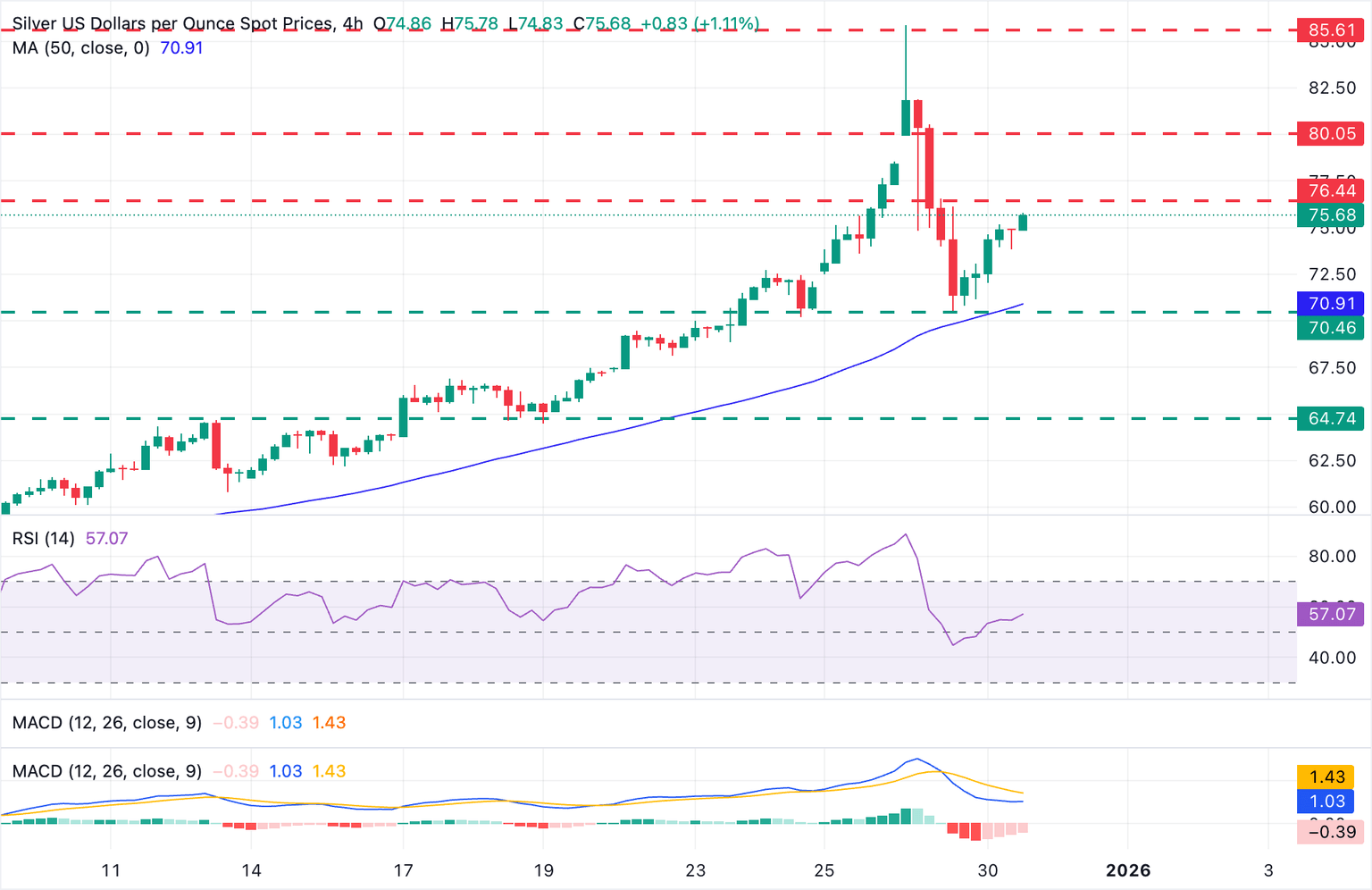
On the 4-hour chart, XAG/USD is trading at $75.65, after bottoming at $70.53 on Monday. The bullish 50-period simple moving average (SMA), near $70.89, sustained the downward move on Monday and kept the broader uptrend intact.
However, oscillators are mixed. The Moving Average Convergence-Divergence (MACD) line remains below the signal line and below the zero mark, while the Relative Strength Index (RSI) has returned to bullish territory above the key 50 line.
A bearish engulfing pattern on the daily chart is a negative signal that may indicate a deeper correction. Resistance is located at the $76.50 level during the day, just ahead of the $80.00 psychological level and the all-time high at $85.87.
On the downside, the 50-period simple moving average and Monday’s low at $70.53 will likely provide support in the event of a potential bearish reversal. In case of further decline, the focus will be on the low recorded on December 18, near $64.75.
(Technical analysis of this story was written with the help of an artificial intelligence tool)
Frequently asked questions about silver
Silver is a precious metal that is widely traded among investors. It has been used historically as a store of value and medium of exchange. Although less popular than gold, traders may turn to silver to diversify their investment portfolio, for its intrinsic value or as a potential hedge during periods of high inflation. Investors can buy physical silver, in the form of coins or bullion, or trade it through instruments such as exchange-traded funds, which track its price in international markets.
Silver prices can move due to a wide range of factors. Geopolitical instability or fears of a deep recession could cause the price of silver to rise due to its safe-haven status, although to a lesser extent than the price of gold. As a non-yielding asset, silver tends to rise as interest rates fall. Its movements also depend on how the US dollar (USD) behaves as the asset is priced in dollars (XAG/USD). A strong dollar tends to keep the price of silver at bay, while a weak dollar is likely to push prices higher. Other factors such as investment demand, mining supplies – silver is more plentiful than gold – and recycling rates can also influence prices.
Silver is widely used in industry, especially in sectors such as electronics or solar energy, as it has one of the highest electrical conductivity of all metals – more than copper and gold. A rise in demand can cause prices to rise, while a fall tends to bring them down. Dynamics in the economies of the United States, China and India can also contribute to price fluctuations: for the United States, and especially China, its large industrial sectors use silver in various processes; In India, consumer demand for the precious metal used in jewelery also plays a major role in determining prices.
Silver prices tend to follow gold movements. When gold prices rise, silver usually follows suit, as its status as a safe haven asset is similar. The gold/silver ratio, which shows how many ounces of silver are needed to equal the value of one ounce of gold, may help determine the relative valuation between the two metals. Some investors may consider a high ratio to be an indication that silver is undervalued, or that gold is undervalued. Conversely, a low ratio may indicate that gold is undervalued compared to silver.