
The USD/CAD pair is trading 0.1% higher to near 1.3900 during the early European trading session on Thursday. The Canadian pair is trading higher as the US dollar remains broadly flat amid expectations that the Federal Reserve (Fed) will keep interest rates steady in its January 28 monetary policy announcement.
At the time of writing, the US Dollar Index (DXY), which tracks the value of the dollar against six major currencies, is trading slightly higher near a monthly high of 99.26.
Expectations of the Fed to leave interest rates steady in a range of 3.50%-3.75% intensified at this month’s policy meeting after the release of US CPI data for December, which showed that price pressures grew steadily.
Meanwhile, the Canadian Dollar (CAD) remains broadly weak as weak labor market conditions heighten expectations of a Bank of Canada rate cut in the near term. Statistics Canada showed last week that the unemployment rate rose sharply to 6.8% in December from the previous reading of 6.5%.
Technical analysis of the USD/CAD pair
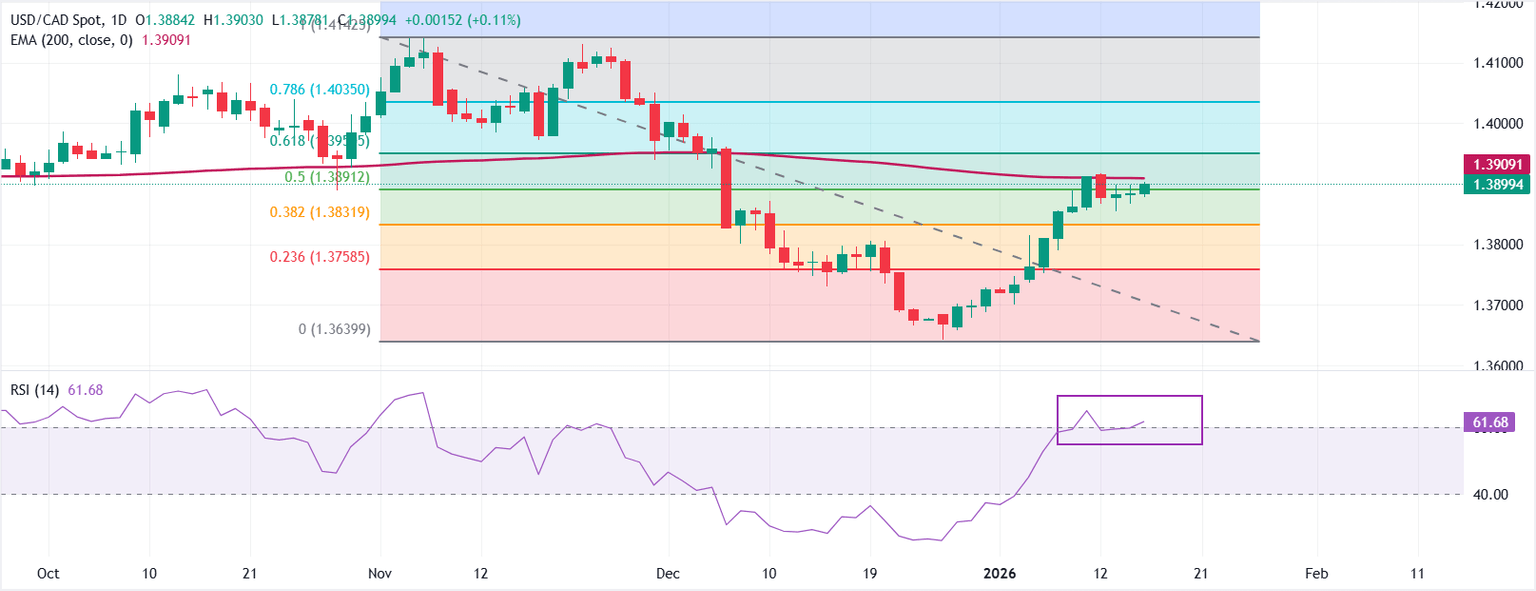
USD/CAD is trading higher near 1.3900 at the time of writing. The 200-day Exponential Moving Average (EMA) is heading marginally lower near 1.3909, keeping rallies contained. Price action is hovering around this long-term average, and a decisive close above it would relieve downward pressure.
The 14-day RSI at 61.68 shows an improvement in bullish momentum without reaching the overbought zone.
Measured from the high of 1.4143 to the low of 1.3640, the 50% Fibonacci retracement levels at 1.3891 are being tested, while the 61.8% Fibonacci retracement levels are being tested at 1.3951.
Confirming the trend requires a clear breakout above the 200-day EMA, which could open the way to the 1.4000 psychological level.
(The technical analysis for this story was written with the help of an artificial intelligence tool.)
Frequently asked questions about the US dollar
The US dollar (USD) is the official currency of the United States of America, and the “de facto” currency of a large number of other countries where it is traded alongside local banknotes. It is the world’s most traded currency, accounting for more than 88% of total global forex trading volume, or an average of $6.6 trillion in transactions per day, according to 2022 data. After World War II, the US dollar took the place of the British pound as the world’s reserve currency. For most of its history, the US dollar was backed by gold, until the Bretton Woods Agreement in 1971 when the gold standard disappeared.
The most important factor affecting the value of the US dollar is monetary policy, which is shaped by the Federal Reserve. The Fed has two missions: achieving price stability (controlling inflation) and promoting full employment. The basic tool for achieving these two goals is adjusting interest rates. When prices rise too quickly and inflation is above the Fed’s 2% target, the Fed will raise interest rates, which helps the value of the US dollar. When the inflation rate falls below 2% or when the unemployment rate is very high, the Fed may cut interest rates, which affects the dollar.
In extreme cases, the Fed could also print more dollars and activate quantitative easing (QE). Quantitative easing is the process by which the Federal Reserve dramatically increases the flow of credit into a stuck financial system. It is a non-standard policy measure used when credit dries up because banks will not lend to each other (due to fear of the counterparty defaulting). It is a last resort when simply lowering interest rates is unlikely to achieve the necessary result. It has been the Fed’s weapon of choice to combat the credit crunch that occurred during the Great Financial Crisis of 2008. This involves the Fed printing more dollars and using them to buy U.S. government bonds mostly from financial institutions. Quantitative easing usually leads to a weakening of the US dollar.
Quantitative tightening (QT) is the reverse process whereby the Fed stops purchasing bonds from financial institutions and does not reinvest capital from bonds it holds outstanding in new purchases. It is usually positive for the US dollar.